
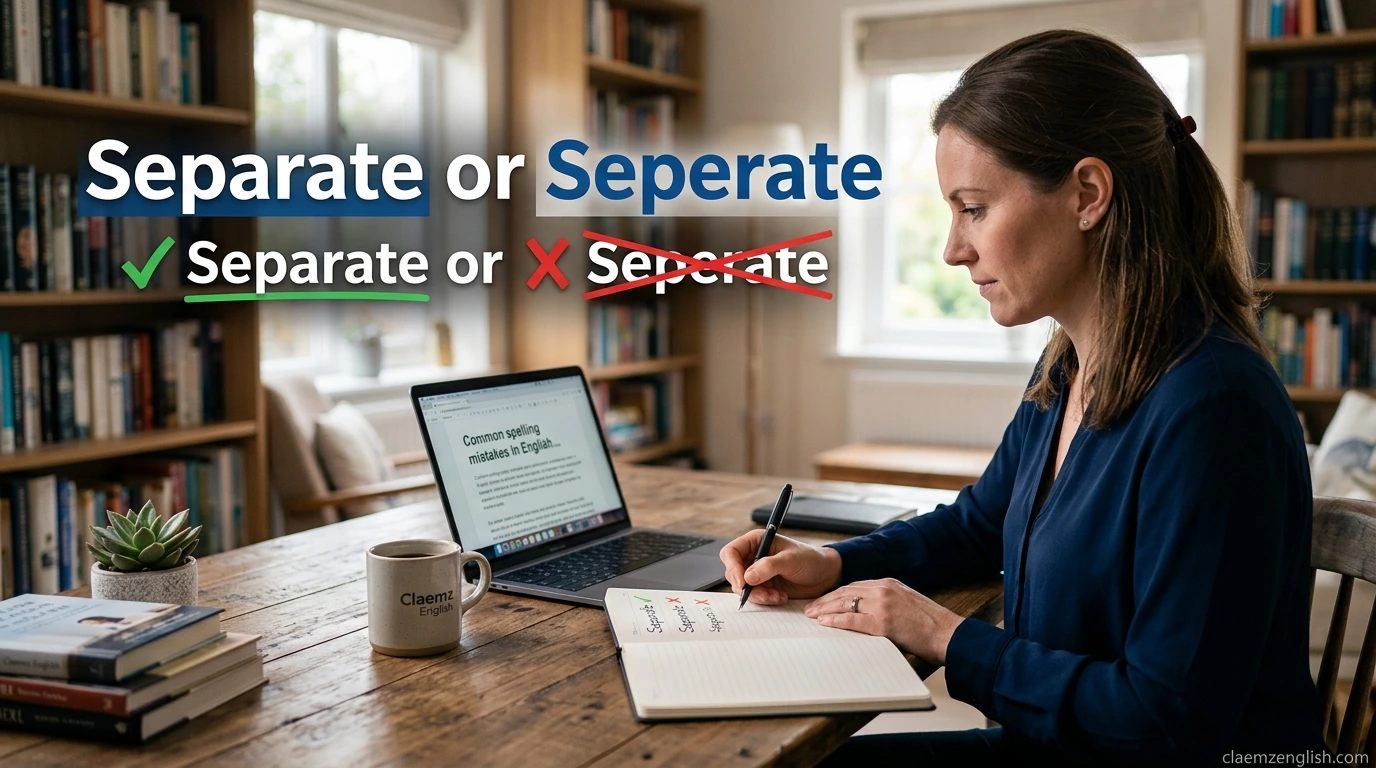
Many English learners, students, and even native speakers often wonder whether “separate” or “seperate” is the correct spelling. It’s one of the most commonly misspelled words in English because its pronunciation can make people think it should be written differently.
Getting this spelling right matters in everyday writing, school assignments, exams, emails, job applications, and professional communication. A simple spelling mistake can make your writing look less polished and sometimes affect your credibility.
The good news is that the answer is straightforward: “separate” is correct, while “seperate” is incorrect. In this guide, you’ll learn why people confuse these spellings, how to remember the correct form, grammar rules, pronunciation tips, examples, common mistakes, and easy tricks to avoid the error forever.
What Does “Separate” Mean?
The word separate generally means to divide, disconnect, keep apart, or exist independently from something else.
It can be used as:
- A verb
- An adjective
- Occasionally a noun-related form in specific contexts
As a Verb
When used as a verb, separate means to divide or split things.
Examples:
- Please separate the white clothes from the colored ones.
- The teacher separated the students into groups.
- Oil and water naturally separate.
As an Adjective
When used as an adjective, it means distinct, individual, or not connected.
Examples:
- They live in separate houses.
- We booked separate hotel rooms.
- The report contains separate sections for each topic.
The meaning remains connected to the idea of things being apart or independent.
Separate vs Seperate: Which Spelling Is Correct?
The correct spelling is:
✅ Separate
The incorrect spelling is:
❌ Seperate
Many people mistakenly write seperate because they hear a sound similar to “e” in the middle of the word. However, standard English spelling uses “a” in the second syllable.
Quick Comparison Table
| Word | Correct? | Meaning |
| Separate | ✅ Yes | Divide, distinct, independent |
| Seperate | ❌ No | Misspelling of separate |
Examples
Correct:
- We need to separate the documents.
- The twins attend separate schools.
Incorrect:
- We need to seperate the documents.
- The twins attend seperate schools.
Remember: There is no standard English word called “seperate.”
Why Do People Misspell “Separate”?
The spelling mistake happens because English pronunciation and spelling do not always match perfectly.
When spoken quickly, many people pronounce separate somewhat like:
sep-er-it
or
sep-rit
This pronunciation can trick writers into using an extra “e” instead of “a.”
Common Reasons for Confusion
- The middle vowel sound is not strongly pronounced.
- Similar-looking words use different vowel patterns.
- English spelling contains many exceptions.
- People write the word from memory instead of checking it.
Words Commonly Misspelled Like Separate
| Correct | Common Mistake |
| Separate | Seperate |
| Definitely | Definately |
| Necessary | Neccessary |
| Accommodation | Accomodation |
| Occasion | Ocassion |
Because separate is frequently used, its misspelling appears often in emails, essays, and online posts.
How to Remember the Correct Spelling of Separate
Learning a memory trick can help you avoid the mistake permanently.
Trick 1: Think of “A Rat”
Notice the letters:
sep-A-RAT-e
Many teachers use the phrase:
“There is a rat in separate.”
Since A RAT appears in the middle of the word, you can remember that the spelling uses A, not E.
Trick 2: Break It Into Parts
Separate can be divided into:
- Sep
- A
- Rate
Visualizing these sections can make the spelling easier to recall.
Trick 3: Write It Repeatedly
Practice writing:
- separate
- separate
- separate
Repeated exposure helps build muscle memory.
Trick 4: Use It in Sentences
Examples:
- Separate the files.
- We have separate bedrooms.
- The roads separate near the bridge.
The more you use the word correctly, the easier it becomes to remember.
Grammar Rules for Using “Separate”
Understanding how the word functions grammatically can improve both spelling and usage.
Separate as a Verb
Structure:
separate + object
Examples:
- Separate the papers by category.
- The manager separated the tasks among employees.
- Please separate recyclable waste.
Separate as an Intransitive Verb
Sometimes no object follows.
Examples:
- The groups separated after the meeting.
- The crowd slowly separated.
Separate as an Adjective
Structure:
separate + noun
Examples:
- separate rooms
- separate accounts
- separate entrances
Grammar Table
| Part of Speech | Example | Meaning |
| Verb | Separate the papers. | Divide them |
| Verb | The groups separated. | Went apart |
| Adjective | Separate offices | Distinct offices |
| Adjective | Separate issues | Different issues |
Understanding the grammatical role helps ensure correct sentence construction.
Pronunciation of “Separate”
Pronunciation often contributes to the spelling confusion.
As an Adjective
SEP-er-it
Example:
- We have separate offices.
Approximate pronunciation:
/ˈsepərət/
As a Verb
SEP-uh-rate
Example:
- Please separate the documents.
Approximate pronunciation:
/ˈsepəreɪt/
Pronunciation Comparison
| Usage | Pronunciation |
| Adjective | SEP-er-it |
| Verb | SEP-uh-rate |
| Misspelling “seperate” | Not a correct English word |
Although the pronunciation changes slightly depending on usage, the spelling remains separate in all cases.
Examples of Correct Usage in Sentences
Seeing the word in real-life contexts makes it easier to remember.
Everyday Conversations
- Let’s keep these items separate.
- The siblings sleep in separate rooms.
- Please separate the clean clothes from the dirty ones.
- Their offices are in separate buildings.
- We decided to separate the expenses equally.
Academic Writing
- The research discusses three separate theories.
- Students were separated into small groups.
- The report contains separate chapters.
Workplace Communication
- Please separate confidential files from public records.
- The company operates through separate departments.
- Separate invoices should be submitted for each project.
Travel and Daily Life
- We booked separate flights.
- The luggage was separated during inspection.
- The park has separate areas for children and adults.
Common Mistakes and How to Avoid Them
Many writers repeatedly make the same errors.
Mistake 1: Writing “Seperate”
Incorrect:
❌ We need to seperate the files.
Correct:
✅ We need to separate the files.
Mistake 2: Mixing Up Verb and Adjective Usage
Incorrect:
❌ Please keep the documents separately folders.
Correct:
✅ Please keep the documents in separate folders.
Mistake 3: Confusing Separate and Separately
Separate = adjective or verb
Separately = adverb
Examples:
- We work in separate offices.
- We work separately on projects.
Comparison Table
| Word | Part of Speech | Example |
| Separate | Verb | Separate the papers. |
| Separate | Adjective | Separate rooms. |
| Separately | Adverb | They traveled separately. |
Mistake 4: Trusting Spellings Based on Pronunciation
Many learners write words exactly as they hear them.
Incorrect thinking:
It sounds like “seperate,” so I’ll spell it that way.
Correct approach:
English spelling often differs from pronunciation.
Always verify uncertain spellings.
Separate in British and American English
Unlike many English words, separate has the same spelling in both British and American English.
British English
- separate room
- separate issue
- separate account
American English
- separate room
- separate issue
- separate account
Comparison Table
| English Variety | Correct Spelling |
| British English | Separate |
| American English | Separate |
| Australian English | Separate |
| Canadian English | Separate |
There is no regional version that uses “seperate.”
Words Related to Separate
Learning related words helps expand vocabulary and improve understanding.
Separation
Meaning: the act of dividing or being apart.
Examples:
- The separation took several months.
- The company announced a separation of departments.
Separately
Meaning: independently or individually.
Examples:
- The teams worked separately.
- The items were packaged separately.
Separated
Meaning: divided or no longer together.
Examples:
- The children became separated in the crowd.
- The couple has been separated for a year.
Related Forms Table
| Word | Part of Speech | Meaning |
| Separate | Verb/Adjective | Divide or distinct |
| Separated | Adjective/Verb | Divided |
| Separately | Adverb | Independently |
| Separation | Noun | Division or distance |
FAQs
Is “seperate” ever correct?
No. Seperate is always considered a misspelling in standard English.
Why do people write “seperate”?
The pronunciation can make it sound like the middle vowel is an “e,” leading many people to spell it incorrectly.
Is “separate” a verb or an adjective?
It can be both.
Verb:
- Separate the papers.
Adjective:
- Separate offices.
How can I remember the spelling?
Use the memory trick:
There is “a rat” in sep-a-rat-e.
This helps remind you that the word contains A, not E.
Do British and American English spell it differently?
No. Both use separate.
Is “separately” related to separate?
Yes. Separately is the adverb form of separate.
Example:
- The students sat separately.
Is “separated” spelled with an “a” too?
Yes.
Correct:
- separated
- separation
- separately
All related forms keep the a.
Conclusion
The answer is simple and worth remembering: “separate” is the correct spelling, while “seperate” is always incorrect. Although pronunciation causes confusion, standard English consistently uses the letter A in the middle of the word.
To remember it easily, think of the popular memory trick: “There is a rat in sep-a-rat-e.” This small reminder can help you avoid one of the most common spelling mistakes in English.
Whether you’re writing essays, emails, reports, exam answers, or social media posts, using separate correctly will make your writing look more professional and polished. The next time you’re unsure, remember: separate = correct, seperate = wrong. Once you practice it a few times, you’ll be able to spell and use it confidently every time.
