
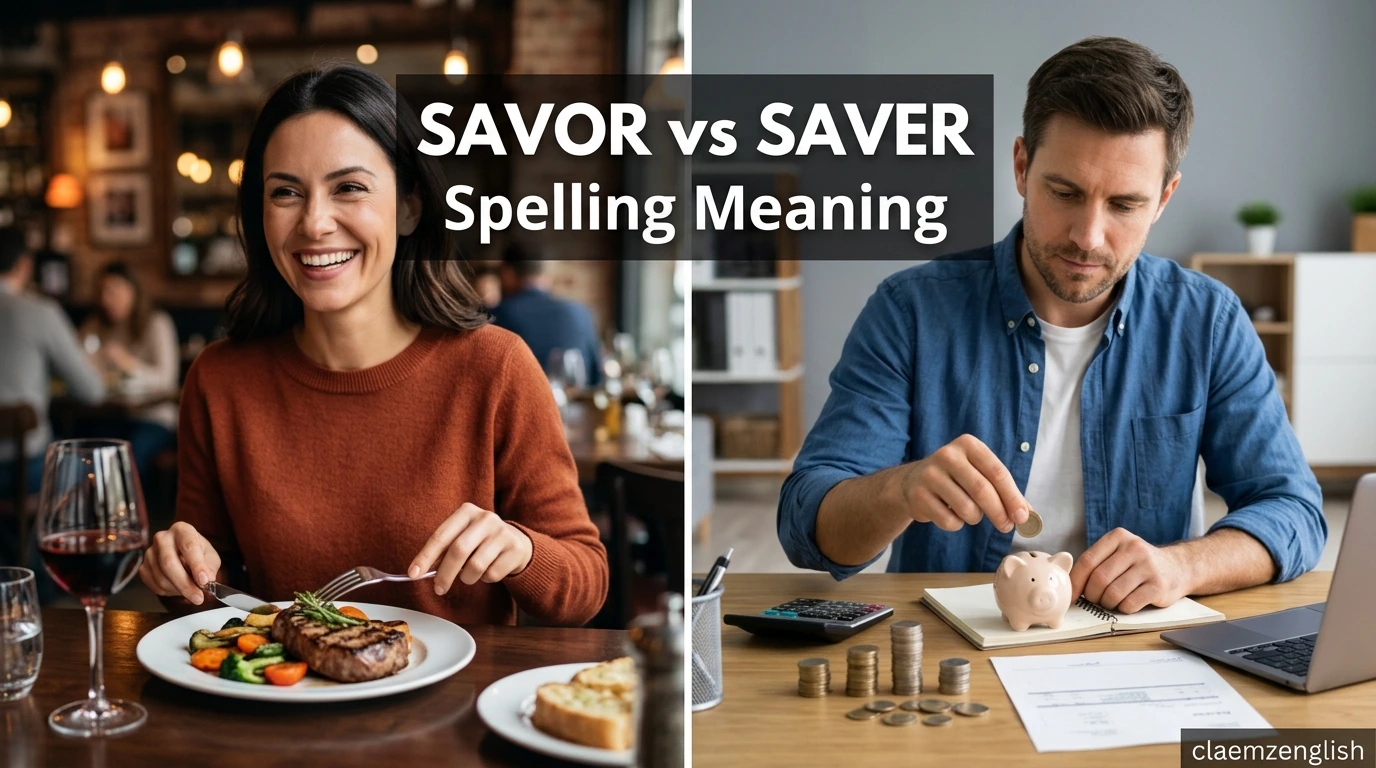
Have you ever paused while writing and wondered whether you should use savor or saver? Although these two words look almost identical, they have completely different meanings and uses. Mixing them up can change the meaning of your sentence and make your writing confusing.
This confusion is common among students, English learners, writers, and even native speakers because the words are pronounced similarly in some accents. Whether you’re writing an email, completing an exam, creating content, or simply improving your English, knowing the difference between savor and saver helps you communicate more clearly and confidently.
In this guide, you’ll learn the meaning of each word, how to use them correctly, spelling differences, pronunciation tips, grammar rules, and plenty of real-life examples. By the end, you’ll never confuse savor and saver again.
What Do Savor and Saver Mean?
The easiest way to remember these words is that they belong to different parts of speech and describe different ideas.
- Savor is mainly a verb meaning to enjoy something fully or appreciate it slowly. It can also be used as a noun to mean taste or flavor, though this is less common.
- Saver is a noun referring to a person or thing that saves. It may describe someone who saves money, time, energy, or even lives.
Although only one letter is different, the meanings are completely unrelated.
Quick Comparison
| Word | Part of Speech | Meaning | Example |
| Savor | Verb (sometimes noun) | To enjoy or appreciate fully | Savor every moment of your vacation. |
| Saver | Noun | A person or thing that saves | She’s a careful saver who plans for the future. |
Simple Definitions
Savor
Means to:
- Enjoy slowly
- Appreciate deeply
- Take pleasure in something
- Experience something completely
Saver
Means:
- Someone who saves money
- Something that reduces cost or time
- A person who rescues or protects
- A product that helps conserve resources
Examples
Savor
- Savor every bite of the delicious cake.
- We should savor these peaceful evenings.
- She savored her success after years of hard work.
Saver
- My grandfather is an excellent saver.
- This app is a real time saver.
- Buying in bulk can be a money saver.
Spelling Difference Between Savor and Saver
One letter makes a big difference.
| Word | Ends With | Meaning |
| Savor | -or | Enjoy something fully |
| Saver | -er | Person or thing that saves |
A useful memory trick is:
- Savor = Enjoy
- Saver = Save
Notice that save is already part of the word saver, making it easier to remember.
Why People Mix Them Up
Many English learners confuse these words because:
- They look very similar.
- Their pronunciation can sound close.
- Both begin with “sav.”
- Typing quickly often leads to spelling mistakes.
- Auto-correct doesn’t always catch errors if both words are correctly spelled.
Fortunately, once you understand their meanings, choosing the correct word becomes much easier.
Grammar Rules and Parts of Speech
Understanding grammar is one of the easiest ways to avoid mistakes.
Savor as a Verb
A verb shows an action.
Examples:
- I savor good coffee every morning.
- They savored every minute together.
- She will savor the opportunity.
Notice that savor describes an action someone performs.
Savor as a Noun
Less commonly, savor means flavor or distinctive taste.
Examples:
- The soup had a rich savor.
- The herbs added extra savor to the meal.
This noun usage appears more often in literary or formal writing than in everyday conversation.
Saver as a Noun
Saver names a person or thing.
Examples:
- He’s a disciplined saver.
- The new software is a huge time saver.
- Solar panels are energy savers.
Unlike savor, saver is not used as a verb.
Grammar Comparison Table
| Feature | Savor | Saver |
| Part of speech | Verb, noun | Noun |
| Describes action | Yes | No |
| Refers to person | No | Yes |
| Refers to object | Rarely | Yes |
| Common in everyday English | Yes | Yes |
How to Use Savor Correctly
The word savor appears frequently when talking about experiences, emotions, food, memories, achievements, or special moments.
Think of it as encouraging someone to slow down and truly enjoy something.
Common Situations
People often use savor when discussing:
- Delicious meals
- Beautiful scenery
- Family memories
- Vacations
- Achievements
- Music
- Quiet moments
- Special celebrations
Examples
- Savor the moment before graduation ends.
- She savored every compliment.
- We savored the beautiful sunset.
- He savored the silence after the storm.
- Take time to savor your success.
Correct vs Incorrect
✅ Correct: Savor every bite of your dinner.
❌ Incorrect: Saver every bite of your dinner.
✅ Correct: I want to savor this experience.
❌ Incorrect: I want to saver this experience.
✅ Correct: They savored their victory.
❌ Incorrect: They savered their victory.
Notice that savored is the correct past tense.
How to Use Saver Correctly
Unlike savor, the word saver always refers to someone or something that saves.
This can involve:
- Money
- Time
- Energy
- Resources
- Effort
- Lives
Everyday Examples
- She’s a smart saver.
- Coupons are money savers.
- Meal prep is a time saver.
- The backup system is a life saver.
- LED bulbs are energy savers.
Many advertisements also use saver because it highlights saving money or resources.
Common Expressions
You’ll often hear:
- Money saver
- Time saver
- Energy saver
- Space saver
- Life saver
- Screen saver
Each refers to something that helps preserve or reduce waste.
Correct vs Incorrect
✅ Correct: This washing machine is an energy saver.
❌ Incorrect: This washing machine is an energy savor.
✅ Correct: She’s an excellent saver.
❌ Incorrect: She’s an excellent savor.
✅ Correct: The shortcut is a real time saver.
❌ Incorrect: The shortcut is a real time savor.
Pronunciation: Do They Sound the Same?
The pronunciation is similar but the endings are slightly different.
| Word | Pronunciation | Sounds Like |
| Savor | SAY-vər | Ends with “-vor” |
| Saver | SAY-vər | Ends with “-ver” |
In many accents, especially fast speech, the words may sound nearly identical. That’s why context is so important.
For example:
“I like to savor good coffee.”
“My father is a careful saver.”
Even if the pronunciation seems similar, the meaning immediately becomes clear from the rest of the sentence.
Pronunciation Tip
When reading:
- Think savor = enjoy
- Think saver = save
Linking each word with its meaning makes it much easier to remember the correct spelling.
Common Word Forms
Learning related forms helps expand your vocabulary.
| Base Word | Related Forms |
| Savor | savors, savored, savoring |
| Saver | savers |
Examples
Savor
- savor
- savors
- savoring
- savored
Example:
- They are savoring every moment.
- She savored the victory.
Saver
- saver
- savers
Example:
- Budget savers often compare prices.
- Smart savers plan for emergencies.
Unlike savor, saver does not change into verb forms because it is a noun.
Real-Life Sentence Examples of Savor and Saver
Seeing these words in context is one of the best ways to remember how to use them correctly. Below are examples from everyday conversations, school assignments, workplaces, and casual writing.
Examples Using Savor
- Savor every minute with your loved ones.
- We savored the delicious homemade pizza.
- She likes to savor a cup of coffee before work.
- The audience savored every note of the concert.
- I want to savor this achievement after working so hard.
- They savored the peaceful mountain view.
- Take time to savor your success.
- He savored every chapter of the novel.
- We savored the fresh sea breeze.
- She savored her first day at college.
Examples Using Saver
- My sister is an excellent saver.
- This new dishwasher is a water saver.
- Online banking is a huge time saver.
- Buying during sales is a money saver.
- The insulated bottle is an energy saver.
- He’s been a careful saver since childhood.
- Cloud storage is a space saver.
- This shortcut is a real time saver.
- Smart thermostats are energy savers.
- Automatic bill payments can be great time savers.
Common Mistakes and How to Avoid Them
Many learners confuse savor and saver because they differ by only one letter. However, remembering a few simple rules will help you avoid these mistakes.
Mistake 1: Using Saver When You Mean “Enjoy”
❌ Incorrect:
- Saver every moment.
- I want to saver this memory.
✅ Correct:
- Savor every moment.
- I want to savor this memory.
Why?
The sentence is about enjoying something, so savor is the correct word.
Mistake 2: Using Savor for Someone Who Saves Money
❌ Incorrect:
- She’s a good savor.
- He is a careful savor.
✅ Correct:
- She’s a good saver.
- He is a careful saver.
Why?
You’re describing a person who saves money, so saver is correct.
Mistake 3: Confusing “Life Saver” and “Savor”
❌ Incorrect:
- You’re my life savor.
✅ Correct:
- You’re my lifesaver.
Why?
A lifesaver is someone or something that rescues or greatly helps. It has nothing to do with enjoying something.
Mistake 4: Incorrect Verb Forms
❌ Incorrect:
- I savered the experience.
- We are savering the moment.
✅ Correct:
- I savored the experience.
- We are savoring the moment.
Always remember the correct forms:
- savor
- savors
- savored
- savoring
British vs American English
Unlike some English words that have different spellings in British and American English, savor and saver are mostly straightforward.
The main difference involves savor.
| American English | British English | Meaning |
| Savor | Savour | To enjoy fully |
| Saver | Saver | Person or thing that saves |
American English
American English uses:
- savor
- savoring
- savored
Examples:
- Savor every opportunity.
- She savored the meal.
British English
British English generally prefers:
- savour
- savouring
- savoured
Examples:
- Savour every moment.
- We savoured the beautiful weather.
What About “Saver”?
The spelling saver remains the same in both American and British English.
Examples:
- A money saver
- A time saver
- An energy saver
So, if you’re writing for an international audience, remember:
- Savor = American spelling
- Savour = British spelling
- Saver = Correct in both varieties of English
Easy Memory Tricks to Remember the Difference
Simple memory devices can help you choose the correct word instantly.
Trick 1: Connect the Meaning
- Savor = Enjoy
- Saver = Save
This is the easiest rule to remember.
Trick 2: Look for the Action
Ask yourself:
Am I talking about enjoying something?
If yes, use savor.
Example:
- Savor the sunset.
Trick 3: Look for a Person or Thing
Ask yourself:
Am I talking about someone or something that saves?
If yes, use saver.
Example:
- He’s a careful saver.
Trick 4: Remember the Root Word
- saver ← save
- savor ← enjoy
The word save is hidden inside saver, making it easier to remember.
Quick Comparison Table
Here’s a complete side-by-side comparison.
| Feature | Savor | Saver |
| Meaning | Enjoy fully | Person or thing that saves |
| Part of Speech | Verb (sometimes noun) | Noun |
| Action Word | Yes | No |
| Refers to Person | No | Yes |
| Refers to Object | Rarely | Yes |
| American Spelling | Savor | Saver |
| British Spelling | Savour | Saver |
| Example | Savor the moment. | He’s a good saver. |
FAQs
Is it savor or saver?
Both are correct words, but they have different meanings.
- Savor means to enjoy something fully.
- Saver refers to someone or something that saves.
Is savor a verb?
Yes. It is mainly used as a verb.
Example:
- Savor every opportunity.
It can also be used as a noun meaning “taste” or “flavor” in more formal or literary contexts.
Is saver a noun?
Yes.
It refers to a person or thing that saves.
Examples:
- Money saver
- Energy saver
- Careful saver
Is “savor” spelled differently in British English?
Yes.
American English uses:
- savor
British English usually uses:
- savour
Both have the same meaning.
Can “saver” be used as a verb?
No.
The verb is save.
Correct:
- Please save the file.
Incorrect:
- Please saver the file.
Which word is used for enjoying food?
Use savor.
Examples:
- Savor the rich chocolate flavor.
- We savored every bite of dinner.
What is a time saver?
A time saver is something that helps you complete tasks more quickly.
Example:
- Keyboard shortcuts are excellent time savers.
Is “lifesaver” one word?
Yes. In most modern English, lifesaver is commonly written as one word when referring to a person or thing that rescues or greatly helps.
Example:
- Your advice was a lifesaver.
Final Tips for Correct Usage
Before choosing between these words, ask yourself one simple question:
Am I talking about enjoyment or saving?
If it’s about appreciating an experience, food, memory, or special moment, choose savor.
If it’s about saving money, time, energy, space, or describing a person who saves, choose saver.
This quick check will prevent nearly every mistake.
Conclusion
Although savor and saver look alike, they serve very different purposes in English. Savor is primarily a verb that means to enjoy, appreciate, or experience something fully. Saver, on the other hand, is a noun that describes a person or thing that saves money, time, energy, or other valuable resources.
The easiest way to remember the difference is:
- Savor = Enjoy
- Saver = Save
Also keep in mind that savor is the American spelling, while savour is the preferred British spelling. The word saver, however, remains the same in both American and British English.
By understanding their meanings, grammar, pronunciation, and common usage, you can write with greater confidence in school assignments, professional communication, emails, exams, and everyday conversations. Whenever you’re unsure, think about the context—are you talking about enjoying something or saving something? That simple question will help you choose the correct word every time.
