
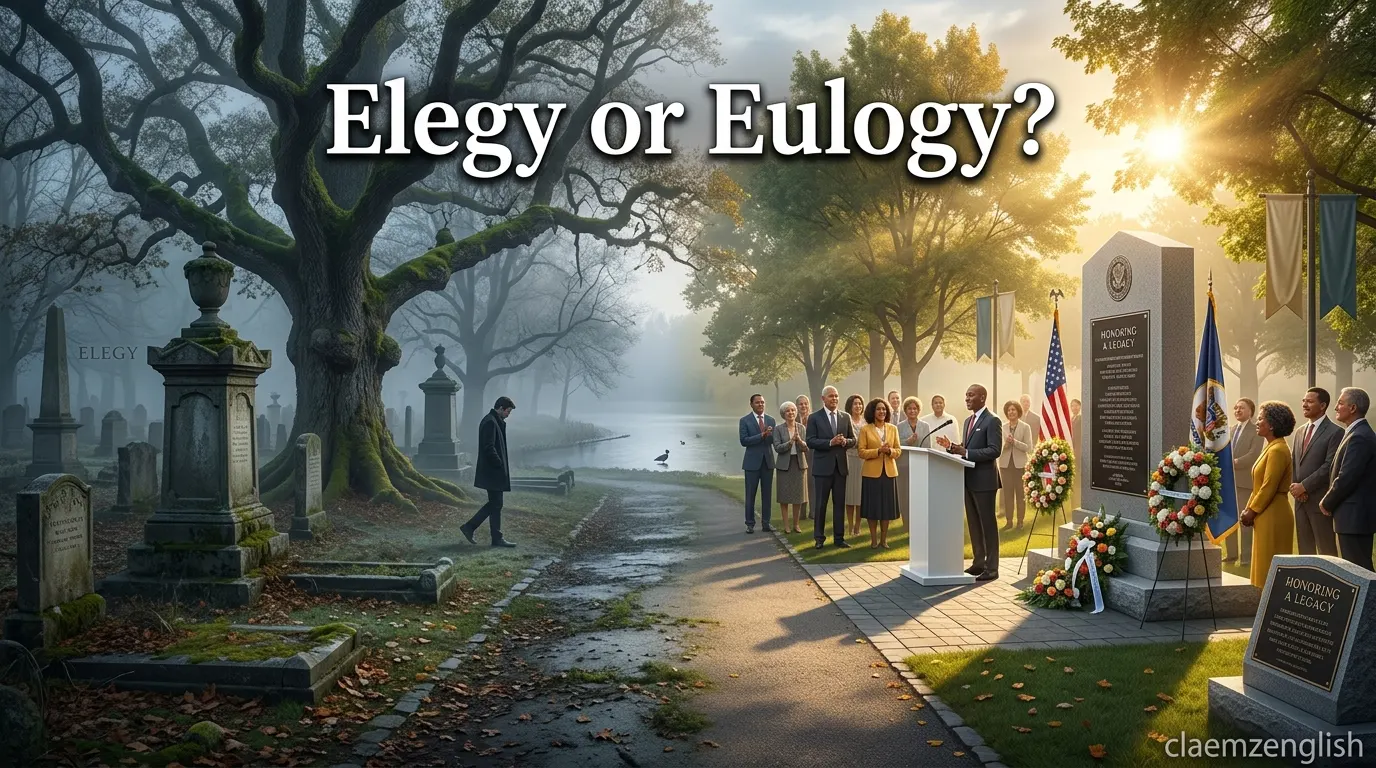
Have you ever wondered whether you should use elegy or eulogy? Many English learners—and even native speakers—mix up these two words because they both relate to death, remembrance, and honoring someone. Although they sound somewhat similar, they have very different meanings and are used in different situations.
Knowing the difference between elegy or eulogy can improve your writing, speaking, academic performance, and professional communication. Whether you’re writing an essay, attending a funeral, reading literature, or preparing a speech, choosing the correct word helps you communicate clearly and respectfully.
In this guide, you’ll learn the meaning of each word, how to use them correctly, pronunciation tips, grammar rules, and plenty of real-life examples. By the end, you’ll never confuse elegy and eulogy again.
What Is an Elegy?
An elegy is a poem or literary work that expresses sorrow, grief, or reflection after someone’s death. While many elegies are written to mourn a specific person, some reflect on loss, mortality, or the passage of time in general.
An elegy belongs to the world of literature and poetry.
Simple definition
Elegy = A poem or piece of writing that mourns someone who has died.
Key characteristics of an elegy
- Usually written as poetry.
- Expresses sadness and remembrance.
- Reflects on life, death, or loss.
- Often found in literature.
- May or may not be read aloud.
Examples
- The poet wrote an elegy after losing his best friend.
- Her moving elegy captured everyone’s emotions.
- Students studied famous elegies in English literature.
Famous examples
Some famous literary elegies include:
- Elegy Written in a Country Churchyard by Thomas Gray
- Lycidas by John Milton
- In Memoriam A.H.H. by Alfred, Lord Tennyson
These works remember people while exploring grief and human mortality.
What Is a Eulogy?
A eulogy is a speech or spoken tribute that praises someone, usually at a funeral or memorial service.
Unlike an elegy, a eulogy is normally spoken rather than written as poetry.
Simple definition
Eulogy = A speech praising and remembering someone who has died.
Key characteristics of a eulogy
- Usually spoken aloud.
- Delivered during funerals or memorial services.
- Focuses on the person’s life and achievements.
- May include personal stories and memories.
- Intended to comfort family and friends.
Examples
- Her daughter delivered a heartfelt eulogy.
- The minister gave a beautiful eulogy at the funeral.
- He was nervous about writing his father’s eulogy.
Elegy vs. Eulogy: What’s the Difference?
Although both words deal with remembering someone who has died, they belong to different forms of expression.
| Feature | Elegy | Eulogy |
| Meaning | A poem of mourning | A speech honoring someone |
| Form | Written poetry or literary work | Spoken speech |
| Purpose | Express grief and reflection | Praise and remember the deceased |
| Usually presented | In books, literature, or writing | At funerals or memorials |
| Tone | Reflective and emotional | Personal, respectful, and celebratory |
Easy memory trick
Think of it this way:
- Elegy = Literature
- Eulogy = Speech
Or remember:
- Elegy → Emotion in poetry.
- Eulogy → You speak it aloud.
When Should You Use “Elegy”?
Use elegy whenever you’re referring to a poem or literary work about death, grief, or remembrance.
Correct situations
✔ Discussing poetry
✔ Studying literature
✔ Writing about famous poets
✔ Describing reflective poems
Examples
- The class analyzed an elegy during literature lessons.
- She published an elegy dedicated to her grandmother.
- His latest collection includes several beautiful elegies.
Incorrect usage
❌ He delivered an elegant elegy at the funeral.
✔ He delivered a touching eulogy at the funeral.
Why?
Because speeches at funerals are called eulogies, not elegies.
When Should You Use “Eulogy”?
Choose eulogy whenever you’re talking about a speech honoring someone’s life.
Correct situations
✔ Funeral speeches
✔ Memorial ceremonies
✔ Public tributes
✔ Spoken remembrance
Examples
- She prepared a moving eulogy.
- Everyone applauded the heartfelt eulogy.
- His eulogy celebrated her kindness and generosity.
Incorrect usage
❌ The famous poet published a eulogy about nature.
✔ The famous poet published an elegy about loss.
A poem is an elegy, not a eulogy.
Grammar Rules and Word Forms
Understanding how these words function grammatically makes them even easier to use.
| Word | Part of Speech | Plural | Common Context |
| Elegy | Noun | Elegies | Literature, poetry |
| Eulogy | Noun | Eulogies | Funerals, memorial speeches |
Related forms
Elegy
- Singular: elegy
- Plural: elegies
- Adjective: elegiac
Examples:
- The poem has an elegiac tone.
- The collection contains several elegies.
Eulogy
- Singular: eulogy
- Plural: eulogies
- Verb: eulogize
- Noun: eulogist (a person who gives a eulogy)
Examples
- She eulogized her mentor beautifully.
- His brother served as the eulogist.
Pronunciation Guide
Many learners confuse these words because they look and sound somewhat alike.
| Word | Pronunciation | Sounds Like |
| Elegy | EL-uh-jee | EL-uh-jee |
| Eulogy | YOO-luh-jee | YOO-luh-jee |
Pronunciation tips
Elegy
- Starts with the sound EL.
- Stress falls on the first syllable.
Eulogy
- Begins with the sound YOU.
- Also stressed on the first syllable.
Reading each word aloud several times helps fix the difference in your memory.
Practice aloud
- She wrote an elegy.
- He delivered a eulogy.
- The elegy was published in a poetry magazine.
- The eulogy brought many people to tears.
Quick Comparison at a Glance
| Question | Elegy | Eulogy |
| Is it poetry? | ✔ Yes | ✘ No |
| Is it a speech? | ✘ No | ✔ Yes |
| Used in literature? | ✔ Frequently | Rarely |
| Used at funerals? | Occasionally if read as poetry | ✔ Almost always |
| Main purpose | Express grief | Honor a person’s life |
Easy Way to Remember
If you’re writing poetry, choose elegy.
If you’re giving a speech, choose eulogy.
One is a literary work.
The other is a spoken tribute.
Making this simple distinction will help you avoid one of the most common vocabulary mistakes in English.
Sentence Examples: Using Elegy and Eulogy Correctly
The best way to remember the difference between elegy and eulogy is to see them used in everyday sentences. Notice how one refers to a poem while the other refers to a speech.
Examples with Elegy
- The author wrote a touching elegy for his late father.
- Students analyzed an elegy in their English literature class.
- Her elegy beautifully expressed the pain of losing a loved one.
- The collection includes several modern elegies.
- The poet composed an elegy after the tragic accident.
- His elegy reflected on love, loss, and hope.
- The magazine published a heartfelt elegy.
- She won an award for her moving elegy.
- The elegy explored themes of memory and grief.
- Many classic poets have written famous elegies.
Examples with Eulogy
- His sister delivered a heartfelt eulogy at the funeral.
- The pastor gave a comforting eulogy.
- She spent hours preparing her grandmother’s eulogy.
- Everyone appreciated the thoughtful eulogy.
- The eulogy celebrated his generosity and kindness.
- He volunteered to give the eulogy.
- Her emotional eulogy brought many guests to tears.
- The family thanked him for his beautiful eulogy.
- A meaningful eulogy can comfort grieving relatives.
- The eulogy highlighted decades of community service.
Correct vs. Incorrect Usage
One of the easiest ways to avoid mistakes is by comparing correct and incorrect sentences.
| ❌ Incorrect | ✔ Correct | Why? |
| She gave an elegy at the funeral. | She gave a eulogy at the funeral. | A funeral speech is a eulogy. |
| He wrote a beautiful eulogy for his poetry book. | He wrote a beautiful elegy for his poetry book. | Poems of mourning are elegies. |
| The poet delivered an elegy to the audience. | The poet read an elegy aloud. | An elegy is a poem, not a speech type. |
| We studied famous eulogies in poetry class. | We studied famous elegies in poetry class. | Literature classes study elegies. |
| The minister published an elegy speech. | The minister delivered a eulogy. | Eulogies are speeches. |
Quick Tip
Ask yourself these questions:
- Is it a poem? → Use elegy.
- Is it a speech honoring someone? → Use eulogy.
If you answer those two questions first, you’ll almost always choose the correct word.
Common Mistakes and How to Avoid Them
Many learners confuse these words because they share similar endings and relate to remembering people after death. Here are the most common mistakes.
Mistake 1: Thinking They Mean the Same Thing
Although both involve remembrance, they are not synonyms.
- Elegy = poem
- Eulogy = speech
Mistake 2: Using Elegy for Funeral Speeches
Incorrect:
She gave an elegant elegy at the memorial.
Correct:
She gave a heartfelt eulogy at the memorial.
Mistake 3: Calling Every Tribute a Eulogy
Not every tribute is a eulogy.
If someone writes a poem expressing grief, it is an elegy, even if it is read during a memorial service.
Mistake 4: Confusing Them Because of Their Similar Sound
The words end similarly, but their beginnings are different.
- EL-egy
- YOU-logy
Saying them aloud several times helps you remember which is which.
Mistake 5: Forgetting the Context
Before choosing either word, think about the situation.
- Literature class → Elegy
- Funeral speech → Eulogy
- Poetry collection → Elegy
- Memorial ceremony → Eulogy
British vs. American English
Unlike many English words, elegy and eulogy have the same spelling and meaning in both British and American English.
| Feature | British English | American English |
| Elegy | Same spelling | Same spelling |
| Eulogy | Same spelling | Same spelling |
| Meaning | Same | Same |
| Pronunciation | Very similar | Very similar |
The only noticeable difference may be a slight variation in accent or vowel sounds depending on the speaker. However, there is no difference in grammar, spelling, or usage.
Whether you’re writing for readers in the UK, the US, Canada, Australia, or other English-speaking countries, you can confidently use these words in the same way.
Tips to Remember the Difference
Memory tricks make confusing words much easier to learn.
Think of Poetry
Elegy begins with E, which can remind you of:
- Emotion
- Expression
- English literature
An elegy expresses grief through poetry.
Think of Speaking
Eulogy contains the sound “you.”
Imagine someone saying:
“You are giving the speech.”
That speech is a eulogy.
Remember the Setting
- Book or poem → Elegy
- Funeral podium → Eulogy
Create Your Own Sentence
For example:
The poet wrote an elegy, and her son delivered a eulogy.
This single sentence helps reinforce both meanings together.
FAQs
Is an elegy always a poem?
Yes. An elegy is traditionally a poem or literary composition expressing sorrow, grief, or reflection after a loss. While modern writing may expand the style, it remains a literary work rather than a speech.
Is a eulogy always spoken?
Usually, yes. A eulogy is typically delivered aloud at a funeral or memorial service. It may be written beforehand, but its purpose is to be spoken.
Can an elegy be read at a funeral?
Yes. Someone may read an elegy during a funeral service. However, the poem itself is still an elegy, while the speech honoring the person is the eulogy.
Which word is more common in everyday English?
Eulogy is generally more common in everyday conversation because people are more likely to discuss funeral speeches than literary poems.
Are elegy and eulogy synonyms?
No.
They both relate to remembering someone who has died, but they describe different things.
- Elegy = poem
- Eulogy = speech
Can a living person receive a eulogy?
Although a eulogy traditionally honors someone who has died, people sometimes jokingly use the word for a speech praising a living person. In formal English, however, a eulogy is associated with memorial services.
What is the plural of elegy?
The plural of elegy is elegies.
Example:
The anthology contains several famous elegies.
What is the plural of eulogy?
The plural of eulogy is eulogies.
Example:
The book includes memorable eulogies delivered by well-known leaders.
Final Thoughts: Remember the Difference with Confidence
Although elegy and eulogy are often confused, the distinction is actually simple once you know their purpose.
An elegy is a poem or literary work that expresses grief, remembrance, or reflection after a loss. It belongs to the world of poetry and literature, where writers explore emotions surrounding death and memory.
A eulogy, on the other hand, is a speech delivered to honor and celebrate someone’s life, most often at a funeral or memorial service. It focuses on the person’s character, achievements, relationships, and the impact they had on others.
To remember the difference, keep this simple rule in mind:
- Elegy = A poem of mourning.
- Eulogy = A speech of praise and remembrance.
Whenever you’re unsure, ask yourself one question:
“Am I talking about a poem or a speech?”
If it’s a poem, choose elegy.
If it’s a speech, choose eulogy.
Mastering this small vocabulary difference will make your writing more accurate, your speaking more confident, and your understanding of English literature and formal communication much stronger. With these examples, grammar tips, and memory tricks, you’ll be able to use elegy and eulogy correctly every time.
