
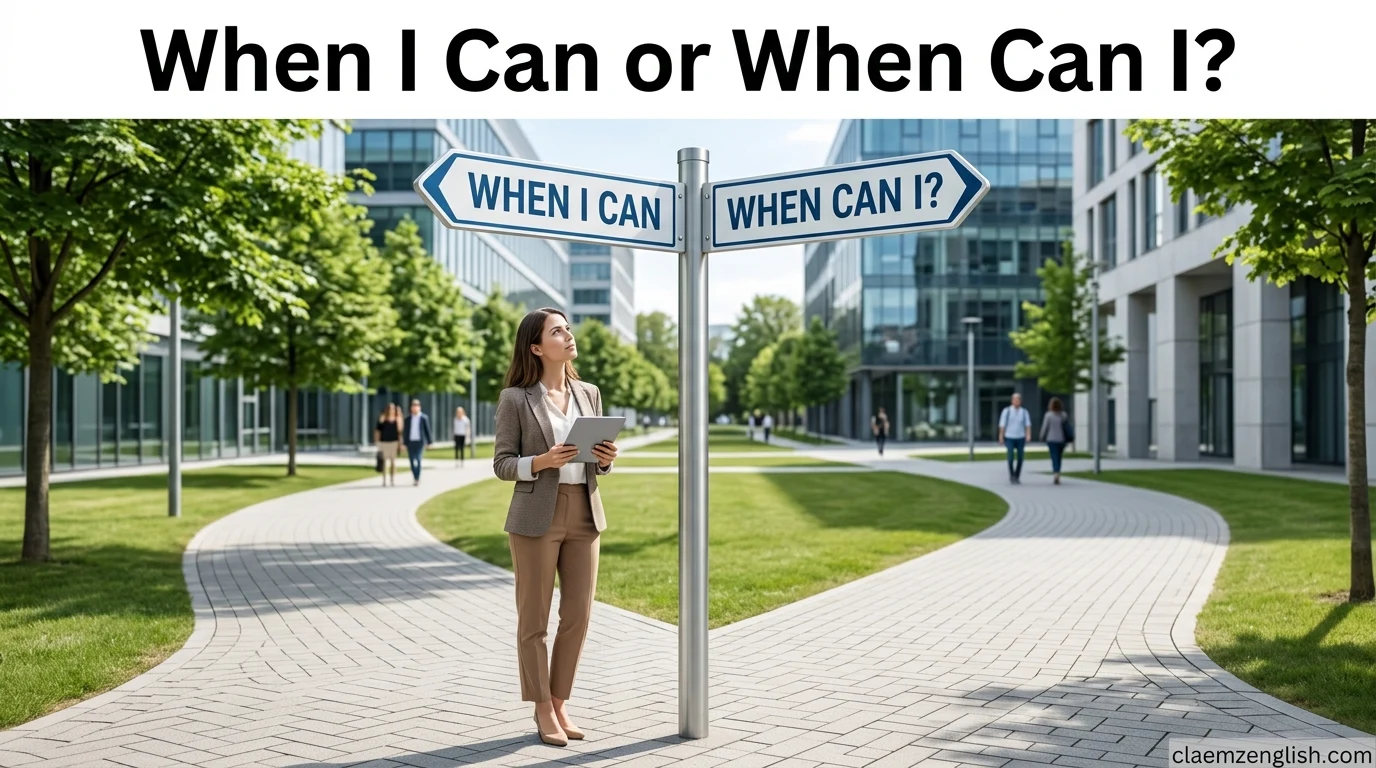
Have you ever paused while writing or speaking and wondered whether you should say “when I can” or “when can I”? You’re not alone. These two phrases look almost identical, but they follow different grammar rules and are used in different situations. Many English learners, students, and even native speakers mix them up because the word order changes depending on whether you’re asking a question or making a statement.
Understanding the difference is important for everyday conversations, emails, exams, interviews, and professional writing. Using the wrong phrase can make your sentence sound unnatural or grammatically incorrect. The good news is that the rule is simple once you understand it.
In this guide, you’ll learn exactly when to use “when I can” and when to use “when can I”, along with easy grammar explanations, comparison tables, real-life examples, and common mistakes to avoid.
What Do “When I Can” and “When Can I” Mean?
Although these expressions contain the same words, they are not interchangeable. Their meanings depend on the sentence structure.
- “When I can” is part of a statement or dependent clause.
- “When can I” is used to ask a direct question.
Think of it this way:
- If you’re asking, use when can I.
- If you’re telling, use when I can.
Quick Comparison
| Phrase | Purpose | Sentence Type | Example |
| When I can | Gives information | Statement/Clause | I’ll call you when I can. |
| When can I | Asks for information | Question | When can I call you? |
Remember this simple rule:
Questions need inversion (“can I”), while statements keep the normal order (“I can”).
Understanding the Basic Grammar Rule
The biggest difference between these phrases is word order.
1. “When Can I” Uses Question Word Order
In English questions, the auxiliary (helping) verb comes before the subject.
Pattern:
When + can + I + verb…?
Examples:
- When can I leave?
- When can I start?
- When can I apply?
- When can I see the results?
- When can I speak to the manager?
These sentences are all asking for information.
2. “When I Can” Uses Statement Word Order
Statements follow the normal English sentence order.
Pattern:
When + I + can + verb
Examples:
- I’ll visit you when I can.
- I’ll answer when I can.
- I’ll finish the report when I can.
- She’ll explain everything when she can.
- We’ll travel when we can afford it.
These sentences are not questions.
Compare the Word Order
| Statement | Question |
| I can come tomorrow. | Can I come tomorrow? |
| I’ll help when I can. | When can I help? |
| I’ll call when I can. | When can I call? |
| I’ll leave when I can. | When can I leave? |
Notice how “can” moves before the subject only in questions.
When to Use “When I Can”
Use “when I can” whenever you’re talking about doing something at the earliest possible opportunity or when circumstances allow.
It often means:
- whenever possible
- as soon as I’m able
- when I have time
- when circumstances permit
Common Situations
You might use when I can when talking about:
- busy schedules
- future plans
- promises
- availability
- personal ability
Examples
- I’ll reply when I can.
- I’ll visit my grandparents when I can.
- I exercise when I can.
- I’ll help you when I can.
- I travel when I can save enough money.
- I’ll finish the project when I can.
- I read books when I can find time.
- I’ll explain everything when I can.
- I’ll return your call when I can.
- I’ll send the documents when I can.
More Natural Examples
Imagine these conversations.
Friend: Can you help me move this weekend?
You: I’ll help when I can.
Boss: Please update me.
Employee: I’ll send the report when I can.
Parent: Call me after class.
Student: I’ll call when I can.
In each case, “when I can” shows willingness, but it also suggests that the exact time depends on availability.
Correct vs. Incorrect Usage
| ✅ Correct | ❌ Incorrect |
| I’ll call you when I can. | I’ll call you when can I. |
| I’ll visit when I can. | I’ll visit when can I. |
| I’ll finish it when I can. | I’ll finish it when can I. |
| I’ll reply when I can. | I’ll reply when can I. |
Notice that “when can I” never follows another clause in this way.
Common Expressions
You’ll often hear:
- when I can
- whenever I can
- as soon as I can
- if I can
- while I can
Examples:
- I travel whenever I can.
- I’ll answer as soon as I can.
- Enjoy your youth while you can.
- I’ll help if I can.
These expressions are all grammatically related and very common in everyday English.
When to Use “When Can I”
Use “when can I” whenever you’re asking about the right time, permission, opportunity, or possibility to do something.
It begins a direct question.
Common Reasons to Ask
People ask when can I… to learn:
- the correct time
- the earliest opportunity
- available schedules
- permission
- deadlines
Examples
- When can I leave?
- When can I start work?
- When can I register?
- When can I expect delivery?
- When can I collect my passport?
- When can I speak with the doctor?
- When can I book tickets?
- When can I use the gym?
- When can I join the meeting?
- When can I submit my assignment?
Each question asks for specific information.
Everyday Conversations
Employee: When can I start my new job?
Customer: When can I pick up my order?
Student: When can I submit the project?
Patient: When can I remove the bandage?
These are all natural uses because the speaker is requesting information.
Correct vs. Incorrect Examples
| ✅ Correct | ❌ Incorrect |
| When can I leave? | When I can leave? |
| When can I apply? | When I can apply? |
| When can I pay? | When I can pay? |
| When can I call you? | When I can call you? |
The incorrect examples sound incomplete because English questions require subject–auxiliary inversion.
Tip to Remember
Ask yourself one simple question:
Am I asking something?
If yes, use:
When can I…?
If no, you’re probably using:
When I can…
This quick check helps prevent one of the most common grammar mistakes made by English learners.
Side-by-Side Comparison: “When I Can” vs. “When Can I”
Understanding the difference becomes much easier when you compare the two phrases directly.
| Feature | When I Can | When Can I |
| Sentence type | Statement or dependent clause | Direct question |
| Word order | Subject before auxiliary | Auxiliary before subject |
| Function | Gives information | Requests information |
| Ends with a question mark | No | Yes |
| Common meaning | Whenever possible | At what time? |
Compare These Sentence Pairs
| Statement | Question |
| I’ll come when I can. | When can I come? |
| I’ll pay when I can. | When can I pay? |
| I’ll visit when I can. | When can I visit? |
| I’ll call when I can. | When can I call? |
| I’ll start when I can. | When can I start? |
Looking at these pairs makes the grammar pattern much easier to recognize. The words are almost the same, but their order changes depending on whether you’re making a statement or asking a question.
By mastering this simple distinction, you’ll sound much more natural in both spoken and written English.
British vs American English Usage (Is There Any Difference?)
Good news: there is no major difference between British and American English when it comes to “when I can” and “when can I”. Both varieties follow the same grammar rules.
However, slight differences appear in tone and usage frequency rather than structure.
Key Insight
- Both British and American English use:
- When can I…? for questions
- When I can for statements
Example (Same in Both)
- When can I see the doctor?
- I’ll see the doctor when I can.
Subtle Usage Preference
| Aspect | British English | American English |
| Formality | Slightly more formal phrasing sometimes | More direct and casual |
| Usage of “when I can” | Common in polite replies | Equally common |
| Structure differences | None | None |
So, you don’t need to worry about regional differences for this grammar point.
Pronunciation and Speaking Tips
Even though the grammar is simple, pronunciation can affect how natural you sound.
Pronunciation Breakdown
- When can I → /wen kæn aɪ/
- When I can → /wen aɪ kæn/
Key Difference in Stress
- In questions, stress often falls on “can”:
- When CAN I go?
- In statements, stress is more balanced:
- I’ll go when I CAN.
Spoken Examples
- When can I leave work today?
- I’ll leave when I can finish this.
Natural Speaking Tip
In fast speech:
- “When can I” often sounds like “wen-kani”
- “When I can” sounds smoother and more connected
This is normal in everyday English and helps you sound fluent.
Common Mistakes Learners Make
Many learners confuse these phrases because they translate directly from their native language or ignore word order rules.
Mistake 1: Using Question Word Order in Statements
❌ I’ll help you when can I.
✅ I’ll help you when I can.
Mistake 2: Using Statement Word Order in Questions
❌ When I can start?
✅ When can I start?
Mistake 3: Mixing Both Structures
❌ When I can I start?
❌ When can I I start?
✅ When can I start?
Why This Happens
Most mistakes come from:
- translating word-for-word from native language
- forgetting inversion in questions
- overthinking grammar rules
Quick Grammar Rules to Remember
Here is the simplest way to master this topic:
Rule 1: Questions Use Inversion
When + can + subject + verb
- When can I go?
- When can I start?
Rule 2: Statements Keep Normal Order
When + subject + can + verb
- I’ll go when I can.
- I’ll start when I can.
Rule 3: “When I can” = Time Depends on Ability
- I’ll do it when I can = I’ll do it when possible
Rule 4: “When can I” = Asking for Permission or Time
- When can I do it? = Asking for allowed time
Comparison Table: Grammar Structures
| Type | Structure | Example |
| Question | When + can + I + verb | When can I leave? |
| Statement | When + I + can + verb | I’ll leave when I can |
| Negative question | When can’t I + verb | When can’t I go? |
| Conditional meaning | When + I can + verb | I’ll go when I can travel |
Real-Life Usage Examples
Let’s see how these phrases appear in everyday life.
At Work
- When can I submit the report?
- I’ll submit it when I can finish it.
At School
- When can I take the test again?
- I’ll retake it when I can prepare better.
Travel
- When can I book my flight?
- I’ll book it when I can afford it.
Health/Personal Life
- When can I start exercising again?
- I’ll exercise when I can recover fully.
Mini Practice Section
Try identifying which one is correct.
- ___ I call you?
- I’ll call you ___ I can.
- ___ I start the course?
- I’ll start the course ___ I can.
Answers
- When can I call you?
- when I can
- When can I start the course?
- when I can
FAQs
When I Can vs When Can I
1. Are “when I can” and “when can I” interchangeable?
No. They have different grammar functions. One is a statement, the other is a question.
2. Why is “When I can” not a question?
Because it follows normal sentence structure, not question inversion.
3. Can I say “When I can I go?”
No. This is grammatically incorrect.
4. Which one is more common?
Both are common, but used in different situations.
5. What is the easiest way to remember?
If you are asking → use When can I
If you are telling → use When I can
Conclusion
The difference between “when I can” and “when can I” is simple once you understand English word order rules. The key idea is that English changes structure depending on whether you are asking a question or making a statement.
- Use “when can I” when you are asking about time, permission, or opportunity.
- Use “when I can” when you are describing doing something whenever it becomes possible.
By practicing with real-life examples and remembering the basic inversion rule, you can avoid one of the most common grammar mistakes in English.
Mastering this small difference will instantly make your English sound clearer, more natural, and more confident in both speaking and writing.
