
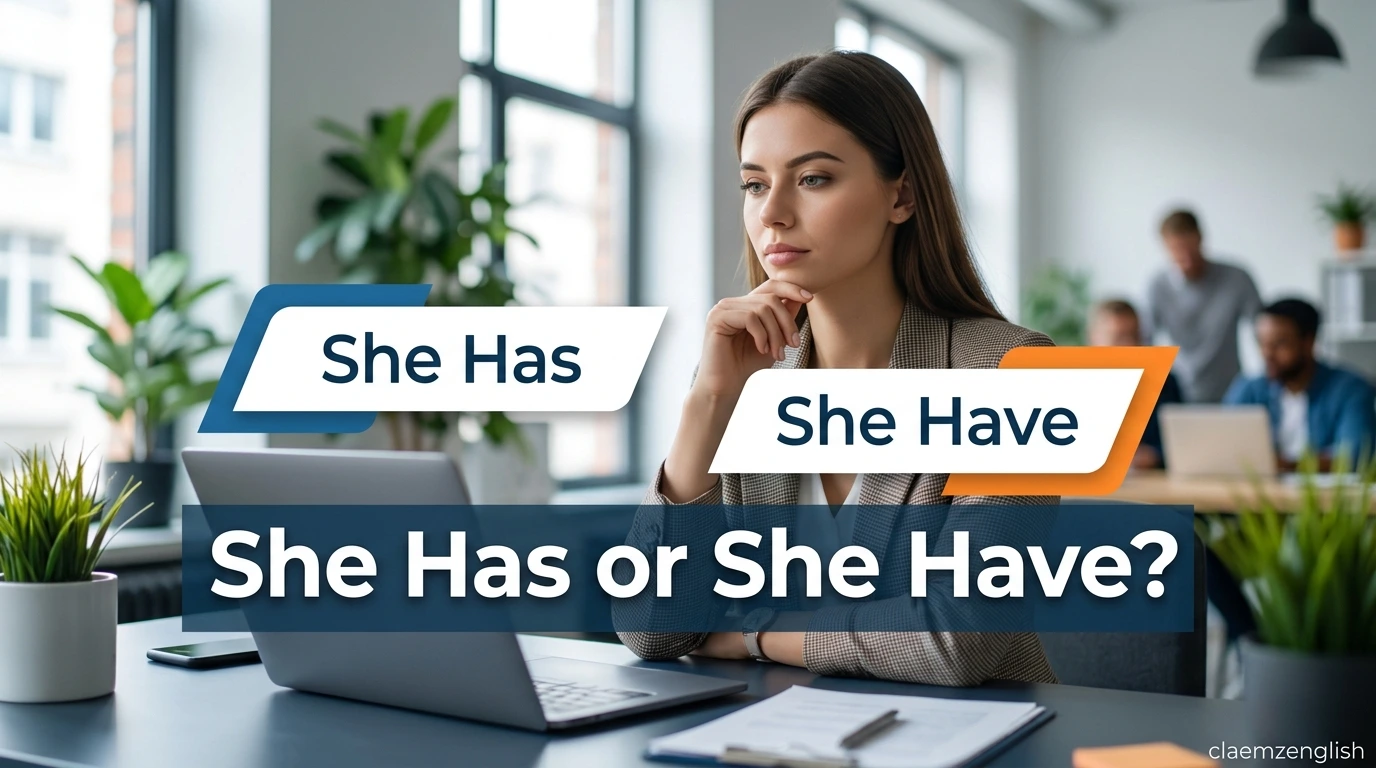
Many English learners pause when writing phrases like “she has” or “she have.” Since both has and have are forms of the same verb, it’s easy to see why this grammar rule causes confusion. However, choosing the correct form is important because even a small mistake can make your writing sound unnatural or incorrect.
Whether you’re writing emails, completing school assignments, preparing for exams, speaking in interviews, or improving your everyday English, knowing when to use she has and when have is correct will make your communication more confident and accurate.
In this complete guide, you’ll learn the grammar rule, understand why she has is correct, see plenty of real-life examples, avoid common mistakes, and remember the rule with simple tips that last.
What Does “She Has” Mean?
The verb has is the third-person singular present tense form of the verb have.
We use has with singular subjects such as:
- He
- She
- It
- A singular person’s name
- A singular noun
The word have expresses:
- Possession
- Relationships
- Experiences
- Obligations (in some structures)
- Auxiliary verb in perfect tenses
Examples:
- She has a new laptop.
- She has two sisters.
- She has a wonderful smile.
- She has many interesting ideas.
- She has enough time today.
In every sentence above, she is singular, so has is the correct verb.
She Has or She Have: Which Is Correct?
The simple answer is:
✅ She has is correct.
❌ She have is incorrect in standard English.
Quick Comparison
| Subject | Correct Verb | Example |
| I | have | I have homework. |
| You | have | You have a question. |
| We | have | We have tickets. |
| They | have | They have bicycles. |
| She | has | She has a bicycle. |
| He | has | He has a dog. |
| It | has | It has four wheels. |
Remember:
- She → Has
- I/You/We/They → Have
This is one of the first grammar rules taught in English because it appears in everyday speech and writing.
Why “She Have” Is Incorrect
English verbs change depending on the subject.
When the subject is third-person singular, the present tense uses has, not have.
Incorrect:
- She have a car.
- She have beautiful handwriting.
- She have many friends.
Correct:
- She has a car.
- She has beautiful handwriting.
- She has many friends.
The mistake usually happens because learners memorize the base verb have without learning how it changes with different subjects.
Understanding the Grammar Rule
The verb have changes in the simple present tense.
Present Tense Forms
| Subject | Verb Form |
| I | have |
| You | have |
| We | have |
| They | have |
| He | has |
| She | has |
| It | has |
Notice that only the third-person singular subjects take has.
Examples:
- I have a notebook.
- You have excellent ideas.
- We have enough food.
- They have arrived.
- He has a meeting.
- She has a presentation.
- It has a long tail.
When “Have” Appears with “She”
Many learners think have can never appear with she.
Actually, it can—but only in certain grammar structures.
1. After Does
Correct:
- She does have a point.
- She does have enough money.
- She does have experience.
Why?
After does, English uses the base verb.
Structure:
She + does + have
Not:
❌ She does has experience.
2. In Infinitive Form
Examples:
- She wants to have lunch.
- She hopes to have more time.
- She plans to have a meeting tomorrow.
Again, the verb after to stays in its base form.
3. With Modal Verbs
Examples:
- She will have dinner soon.
- She may have another chance.
- She should have more patience.
- She could have helped.
Modal verbs always use the base verb have.
Simple Examples of “She Has”
Here are everyday examples.
Possession
- She has a blue backpack.
- She has three children.
- She has a bicycle.
Appearance
- She has green eyes.
- She has curly hair.
- She has a bright smile.
Feelings
- She has confidence.
- She has hope.
- She has courage.
Work
- She has an important meeting.
- She has several responsibilities.
- She has a busy schedule.
School
- She has a science project.
- She has homework tonight.
- She has an exam tomorrow.
Correct vs Incorrect Examples
Learning from mistakes helps you remember faster.
| Correct | Incorrect |
| She has a new phone. | She have a new phone. |
| She has a beautiful garden. | She have a beautiful garden. |
| She has enough experience. | She have enough experience. |
| She has many books. | She have many books. |
| She has an appointment today. | She have an appointment today. |
Notice that every incorrect sentence simply uses the wrong verb form.
She Has in Different Types of Sentences
Positive Sentences
- She has a cat.
- She has plenty of time.
- She has good manners.
Negative Sentences
Notice the verb changes.
Correct:
- She does not have a car.
- She doesn’t have enough money.
- She does not have permission.
Incorrect:
- She doesn’t has a car.
- She does not has permission.
After doesn’t, always use have.
Questions
Correct:
- Does she have a passport?
- Does she have any questions?
- Does she have your number?
Incorrect:
- Does she has a passport?
Again, after does, use have.
She Has in the Present Perfect Tense
The present perfect uses:
has + past participle
Examples:
- She has finished her homework.
- She has completed the project.
- She has arrived.
- She has learned English.
- She has visited Paris.
Here, has is an auxiliary verb, not the main verb.
She Has vs She Is
These expressions are different.
| She Has | She Is |
| She has a dog. | She is happy. |
| She has a job. | She is tired. |
| She has blue eyes. | She is intelligent. |
| She has a question. | She is ready. |
Has shows possession or helps form perfect tenses.
Is describes identity, condition, or state.
Common Situations Where People Get Confused
Confusion 1
Incorrect:
She have lunch every day.
Correct:
She has lunch every day.
Confusion 2
Incorrect:
She doesn’t has homework.
Correct:
She doesn’t have homework.
Confusion 3
Incorrect:
Does she has time?
Correct:
Does she have time?
Confusion 4
Incorrect:
She will has dinner later.
Correct:
She will have dinner later.
Pronunciation Tips
Many learners pronounce has and have similarly.
Has
Usually sounds like:
haz
Example:
She has a pen.
Have
Usually sounds like:
hav
Example:
They have a meeting.
Speaking clearly helps listeners understand your grammar.
British vs American English
Good news!
There is no difference between British English and American English for this grammar rule.
Both varieties use:
- She has
- He has
- It has
Both also use:
- Does she have?
- She doesn’t have.
So regardless of where you’re learning English, the rule stays the same.
Easy Memory Tricks
Try these simple reminders.
Rule 1
If the subject is:
- He
- She
- It
Use:
Has
Rule 2
If the subject is:
- I
- You
- We
- They
Use:
Have
Rule 3
After:
- Does
- Doesn’t
- Did
- Will
- Can
- Should
- Could
- Would
- May
- Might
- To
Always use:
Have
Examples:
- Does she have time?
- She will have dinner.
- She wants to have coffee.
Practice Sentences
Choose the correct answer.
- She ___ a new computer.
- has ✅
- have
- She doesn’t ___ enough money.
- have ✅
- has
- Does she ___ your address?
- have ✅
- has
- She ___ already finished.
- has ✅
- have
- She will ___ breakfast later.
- have ✅
- has
Common Mistakes to Avoid
Avoid these frequent errors.
❌ She have a ticket.
✔ She has a ticket.
❌ She doesn’t has one.
✔ She doesn’t have one.
❌ Does she has class today?
✔ Does she have class today?
❌ She can has another chance.
✔ She can have another chance.
❌ She to has lunch.
✔ She wants to have lunch.
FAQs
Is “she have” ever correct?
Yes, but only after helping verbs or in infinitive structures.
Examples:
- She does have time.
- She will have lunch.
- She wants to have coffee.
By itself in the simple present tense, she have is incorrect.
Why do we say “she has”?
Because she is a third-person singular subject, and English changes have to has for third-person singular subjects in the present tense.
Is “she has” formal or informal?
It is correct in every situation:
- Academic writing
- Business emails
- Daily conversations
- Books
- News articles
- Exams
Why do questions use “have” instead of “has”?
Because does already shows the tense.
Correct:
- Does she have a car?
Not:
- Does she has a car?
Can “has” be a helping verb?
Yes.
Examples:
- She has finished.
- She has written the report.
- She has gone home.
Here, has helps form the present perfect tense.
Quick Summary
Here is a final comparison to remember.
| Situation | Correct Form | Example |
| Simple present | She has | She has a bike. |
| Negative | She doesn’t have | She doesn’t have time. |
| Question | Does she have | Does she have homework? |
| Modal verb | She will have | She will have lunch. |
| Infinitive | To have | She wants to have fun. |
| Present perfect | She has finished | She has completed the work. |
Conclusion
The difference between she has and she have is actually one of the simplest grammar rules once you understand how English verbs agree with their subjects. In the simple present tense, she has is always the correct choice because she is a third-person singular subject. Using she have on its own is a common mistake that should be avoided in formal and everyday English.
Keep these key points in mind:
- Use she has for statements in the present tense.
- Use have after does, doesn’t, modal verbs, and to.
- Remember the easy rule: He, She, It = Has; I, You, We, They = Have.
With regular practice and attention to these patterns, you’ll quickly build confidence and avoid one of the most common English grammar mistakes. The more you read, write, and speak using the correct forms, the more natural they will become, helping you communicate clearly in school, exams, the workplace, and everyday conversations.
