
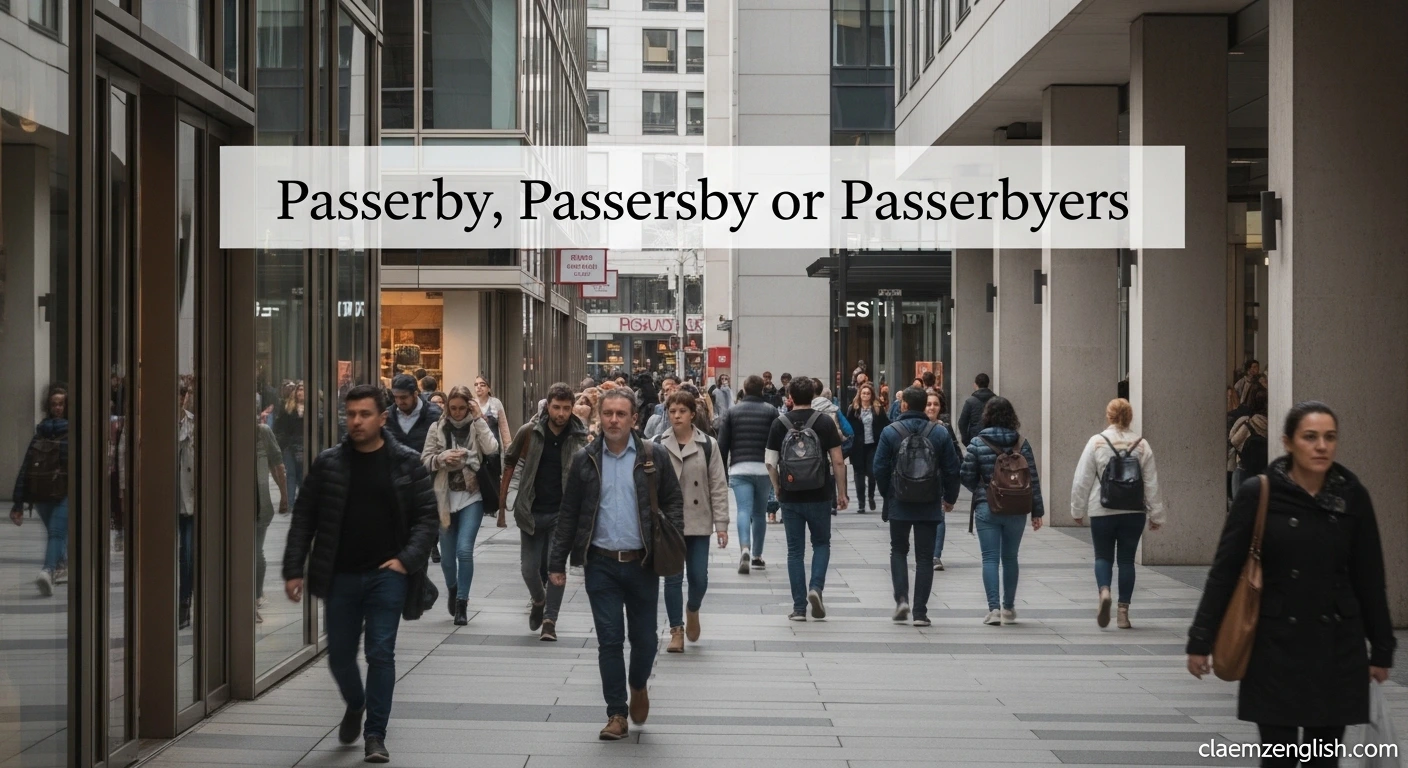
Many English learners get confused when they see words like “passerby,” “passersby,” and sometimes even the incorrect form “passerbyers.” These variations look similar, but only one or two are actually correct in standard English. This confusion is common because English has unusual plural rules, especially for compound words. Knowing the correct form matters in writing essays, professional emails, exams, and everyday communication because even small spelling mistakes can reduce clarity and credibility.
In this article, you’ll learn the correct spelling, meaning, grammar rules, pronunciation, and real-life usage of these terms in a simple and practical way.
What Does “Passerby” Mean?
The word passerby refers to a person who is walking past a place, especially someone who is not directly involved in what is happening there.
It is a compound noun made from:
- passer (someone who passes)
- by (indicating movement past something)
Simple meaning:
A passerby = a person walking past something casually
Examples:
- A passerby helped the injured man.
- The passerby stopped to watch the street performance.
- Police asked a passerby for information about the accident.
Key idea:
A passerby is usually:
- Not involved in the event
- Just moving past
- Sometimes witnessing something briefly
This makes the word very common in news reports, storytelling, and daily conversations.
Passerby vs Passersby vs Passerbyers (Correct Spelling Forms)
This is where most confusion happens. Let’s clearly break down each form.
1. Passerby (Correct – Singular)
Used for one person.
✔ Correct:
- A passerby noticed the fire.
2. Passersby (Correct – Plural)
Used for more than one person.
✔ Correct:
- Passersby gathered around the accident site.
3. Passerbyers (Incorrect)
This form is NOT standard English.
❌ Incorrect:
- Passerbyers stopped to help.
It is wrong because English does not form plural by adding -ers to compound nouns like this.
Comparison Table 1: Correct vs Incorrect Forms
| Form | Correct/Incorrect | Meaning | Example Sentence |
| passerby | Correct | One person passing by | A passerby helped her. |
| passersby | Correct | Multiple people passing | Passersby watched the scene. |
| passerbyers | Incorrect | Not valid English form | ❌ Do not use this form |
Grammar Rules Behind “Passerby” and “Passersby”
To understand why passersby is correct and passerbyers is wrong, we need to look at how compound nouns work in English.
Rule 1: The main noun gets pluralized
In “passerby,” the main noun is passer, not “by.”
So we pluralize:
- passer → passers
- by stays unchanged
✔ passers + by = passersby
Rule 2: No “-ers” doubling rule
English does not allow:
- passer → passerers ❌
- passerby → passerbyers ❌
Rule 3: Compound noun structure matters
Some compound nouns follow this pattern:
| Singular | Plural |
| passerby | passersby |
| mother-in-law | mothers-in-law |
| runner-up | runners-up |
| editor-in-chief | editors-in-chief |
Comparison Table 2: Plural Formation Patterns
| Type of Compound Word | Singular Form | Plural Form | Rule Explanation |
| Standard compound noun | passerby | passersby | Pluralize main noun |
| Hyphenated noun | mother-in-law | mothers-in-law | Plural first noun |
| Verb-based noun | runner-up | runners-up | Plural first part |
| Incorrect form | passerbyers | ❌ Not used | No “-ers” addition rule |
Usage of Passerby and Passersby in Sentences
Understanding meaning is not enough; you must also know how to use the word naturally in sentences.
Passerby (Singular Usage)
- A passerby called the ambulance immediately.
- The passerby gave directions to the tourist.
- A passerby noticed something unusual in the alley.
Passersby (Plural Usage)
- Passersby stopped to watch the parade.
- Several passersby helped clean the street after the accident.
- Passersby often take photos of street art.
Correct vs Incorrect Usage Examples
✔ Correct:
- A passerby saw the robbery.
- Passersby reacted quickly.
❌ Incorrect:
- Passerbyers saw the robbery.
- A passersby saw the accident. (wrong plural agreement)
Real-life Contexts:
You will often see this word in:
- News reports
- Police statements
- Story writing
- Street or public event descriptions
British vs American English Usage
The word passerby / passersby is used in both British and American English in the same way. There is no major difference in spelling or grammar rules between the two.
However, minor differences may appear in sentence style or frequency.
Key point:
✔ Both British and American English use:
- passerby (singular)
- passersby (plural)
Usage tendency:
| Region | Usage Style | Notes |
| British English | Common in formal writing | Often used in news reports |
| American English | Very common in journalism | Frequently appears in headlines |
Example in both styles:
- A passerby helped the injured cyclist.
- Passersby gathered outside the building.
No spelling change is required across regions.
Pronunciation of Passerby and Passersby
Correct pronunciation helps in speaking fluently and confidently.
Passerby pronunciation:
- /ˈpæs.ər.baɪ/
Passersby pronunciation:
- /ˈpæs.ərz.baɪ/
Easy breakdown:
- passer = PAS-er
- by = BY (like “buy”)
Tips for learners:
- Do not pronounce “by” as “bee”
- Stress is on the first syllable: PAS
Spoken Examples:
- A PAS-ser-by helped me.
- Several PAS-serz-by stopped to watch.
Common Mistakes and Confusions
Many learners misuse this word in writing and speech. Let’s look at the most common errors.
1. Adding “-ers” incorrectly
❌ passerbyers
✔ passersby
2. Confusing singular and plural
❌ A passersby helped me
✔ A passerby helped me
3. Wrong verb agreement
❌ Passersby was watching
✔ Passersby were watching
4. Misplacing word order
❌ by passer
✔ passerby
5. Overcorrecting spelling
Some learners try to make it “more English” by adding extra letters, but that creates errors.
Comparison Table 3: Common Mistakes vs Correct Forms
| Mistake Type | Incorrect Form | Correct Form |
| Extra plural ending | passerbyers | passersby |
| Wrong singular usage | passersby helped me | passerby helped me |
| Verb agreement error | passersby was | passersby were |
| Word reversal | by passer | passerby |
FAQs About Passerby and Passersby
1. Is “passerbyers” a correct word?
No, passerbyers is incorrect and not used in standard English.
2. What is the correct plural of passerby?
The correct plural is passersby.
3. Can we say “a passersby”?
No. Use:
- a passerby (singular)
- passersby (plural)
4. Why is it “passersby” and not “passerbys”?
Because the plural is formed on the main noun passer, not by adding “-s” at the end.
5. Is passerby formal or informal?
It is a neutral word used in:
- formal writing (news, essays)
- informal speech
6. Can “passersby” be used in academic writing?
Yes, it is commonly used in essays, reports, and descriptions.
7. What part of speech is passerby?
It is a noun.
Conclusion
The correct understanding of passerby, passersby, and passerbyers is essential for accurate English usage. The key rule to remember is simple:
- ✔ Passerby = one person
- ✔ Passersby = more than one person
- ❌ Passerbyers = incorrect
English compound nouns often follow special plural rules, and in this case, the plural comes from the main word “passer,” not by adding extra endings like “-ers” or “-s” at the end.
By mastering this small but important rule, you can improve your writing clarity, avoid common mistakes, and sound more natural in both spoken and written English. Whether you’re writing an essay, a story, or a professional report, using the correct form will always make your English more accurate and confident.
