
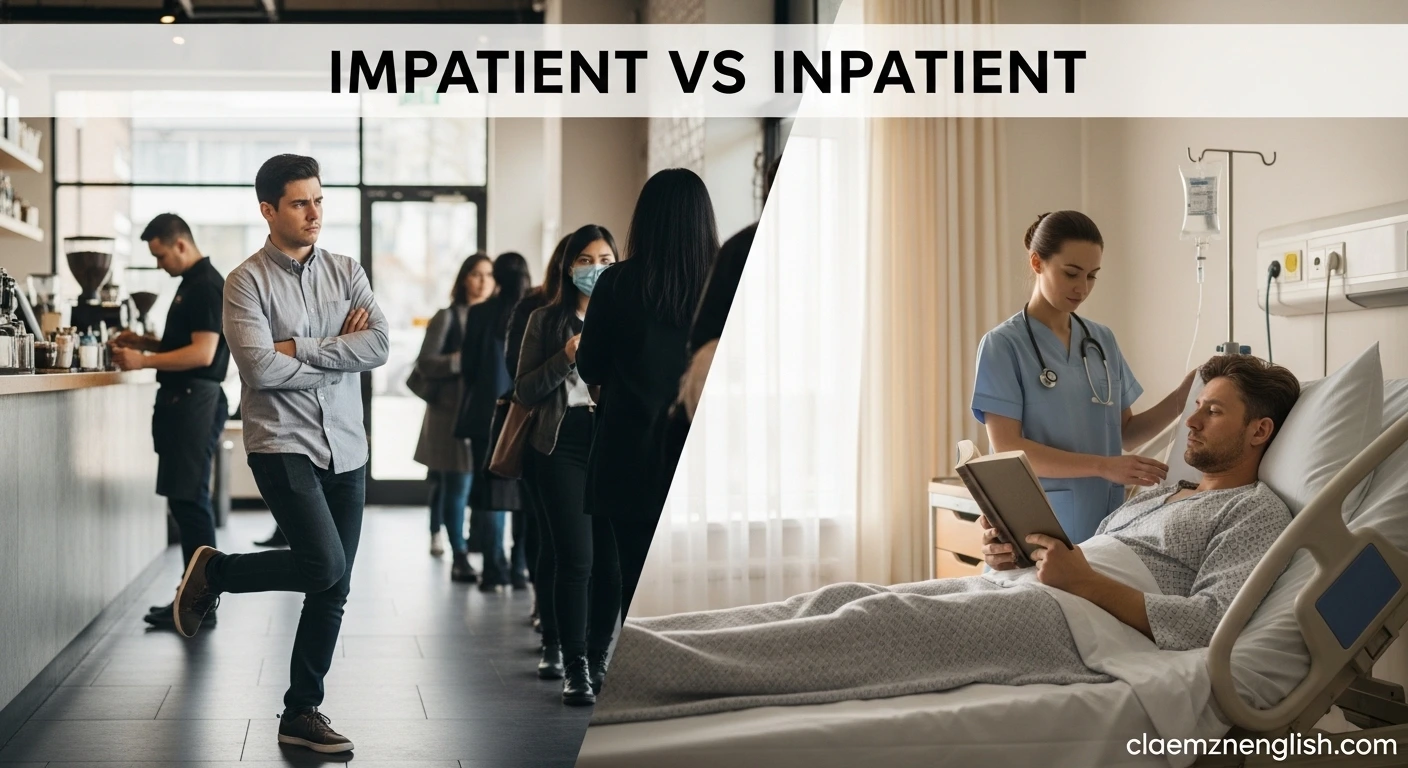
Have you ever read the words impatient and inpatient and wondered if they were just different spellings of the same word? You’re not alone. Because these words look almost identical, many students, writers, and English learners mix them up. However, they have completely different meanings and are used in very different situations.
Understanding the difference between impatient vs inpatient is important for everyday conversations, academic writing, workplace communication, and English exams. Using the wrong word can confuse your readers or even change the meaning of your sentence entirely. For example, saying someone is an inpatient when you mean they are impatient creates a very different message.
In this guide, you’ll learn the meanings of both words, when to use each one, common grammar rules, pronunciation tips, real-life examples, and easy tricks to remember the difference. By the end, you’ll feel confident using both words correctly.
Meaning of Impatient vs Inpatient
Although these words differ by only one letter, they belong to different parts of speech and describe completely different things.
What Does “Impatient” Mean?
Impatient is an adjective. It describes a person who becomes annoyed because something is taking too long or because they must wait.
Someone who is impatient wants things to happen quickly and dislikes delays.
Examples:
- She became impatient while waiting for the bus.
- The children were impatient to open their birthday gifts.
- He grew impatient after standing in line for an hour.
- Don’t be impatient; your turn will come.
Common situations where people become impatient include:
- Waiting in traffic
- Waiting for exam results
- Slow internet connections
- Long customer service calls
- Delayed flights
What Does “Inpatient” Mean?
Inpatient is a noun. It refers to a patient who stays in a hospital or medical facility overnight or for several days to receive treatment.
Unlike an outpatient, an inpatient is admitted to the hospital.
Examples:
- She remained an inpatient after surgery.
- The hospital admitted three new inpatients today.
- He spent five days as an inpatient.
- The doctor recommended inpatient treatment.
This word is commonly used in:
- Hospitals
- Medical reports
- Health insurance documents
- Healthcare discussions
Impatient vs Inpatient: Side-by-Side Comparison
| Feature | Impatient | Inpatient |
| Part of speech | Adjective | Noun |
| Meaning | Not willing to wait | A hospital patient staying overnight |
| Used in | Everyday conversation | Medical settings |
| Refers to | Feelings or behavior | A person receiving hospital care |
| Opposite | Patient | Outpatient |
Quick Memory Trick
Think of inpatient as:
In + patient = a patient who stays “in” the hospital.
Think of impatient as:
Impatient = “I’m tired of waiting!”
This simple association helps many learners remember the correct word instantly.
Correct Usage: When to Use Each Word
Knowing the definitions is only the first step. Let’s see when each word naturally fits into a sentence.
Use “Impatient” When Talking About Feelings
Choose impatient whenever you’re describing someone’s emotions, attitude, or behavior while waiting.
Examples:
- I became impatient during the meeting.
- She sounded impatient on the phone.
- We were impatient because the train was late.
- The customers were growing impatient.
You can often ask yourself:
“Is this sentence talking about someone’s feelings?”
If yes, impatient is probably correct.
Use “Inpatient” When Talking About Medical Care
Use inpatient only when referring to someone admitted to a hospital or healthcare facility.
Examples:
- The inpatient received daily treatment.
- Insurance covers inpatient care.
- The doctor transferred him to the inpatient ward.
- She remained an inpatient for one week.
Ask yourself:
“Is this sentence about hospital treatment?”
If yes, use inpatient.
Spelling Differences That Cause Confusion
Many learners confuse these words because only one letter changes.
| Word | Breakdown | Easy Way to Remember |
| Impatient | im + patient | Feeling frustrated while waiting |
| Inpatient | in + patient | A patient staying in the hospital |
Notice the beginning:
- Im- usually changes the meaning of a word (as in impossible or impolite).
- In- here literally relates to staying in a hospital.
That tiny spelling difference completely changes the meaning.
Visual Comparison
Impatient
- Emotion
- Personality
- Waiting
- Frustration
Inpatient
- Hospital
- Doctor
- Medical care
- Admission
Grammar Rules and Word Forms
Understanding grammar helps you use these words correctly in different sentence structures.
Impatient Is an Adjective
Because it is an adjective, impatient describes nouns.
Examples:
- an impatient customer
- an impatient child
- an impatient teacher
- impatient drivers
It often appears after linking verbs.
Examples:
- She is impatient.
- They became impatient.
- He seems impatient.
Common Grammar Patterns
- impatient with someone
- impatient about something
- impatient for something
- impatient to do something
Examples:
- She is impatient with her brother.
- They were impatient about the delay.
- He was impatient for the holidays.
- The children were impatient to play.
Inpatient Is Usually a Noun
Examples:
- The inpatient needed medication.
- Every inpatient has a private room.
- Nurses check each inpatient regularly.
Sometimes it also functions as an adjective before another noun.
Examples:
- inpatient treatment
- inpatient services
- inpatient care
- inpatient facility
Pronunciation Tips
Because the words look so similar, they can also sound confusing when spoken quickly.
Impatient
Pronounced:
im-PAY-shunt
The stress falls on the second syllable.
Inpatient
Pronounced:
IN-pay-shunt
Notice the first syllable is emphasized more clearly.
Speaking them slowly at first can help you hear the difference.
Practice Sentences
Say these aloud:
- I’m becoming impatient.
- The inpatient needs medication.
- She grew impatient after waiting.
- Every inpatient has a nurse assigned.
Repeated practice makes the distinction much easier to remember.
Real-Life Examples in Everyday English
Here are examples showing how these words naturally appear in conversations.
Examples with “Impatient”
- The audience became impatient because the concert started late.
- My little brother is impatient every Christmas morning.
- Drivers grew impatient during the traffic jam.
- She looked impatient while waiting outside.
- He gets impatient when technology doesn’t work.
- We were impatient to hear the good news.
- The teacher asked everyone not to become impatient.
- Customers became impatient after the long delay.
Examples with “Inpatient”
- The hospital admitted the patient as an inpatient.
- The surgeon recommended inpatient observation.
- Insurance approved inpatient treatment.
- Every inpatient receives three meals each day.
- She remained an inpatient after the operation.
- Nurses visited each inpatient every morning.
- The clinic provides excellent inpatient care.
- His doctor advised several days of inpatient rehabilitation.
These examples show that impatient appears in everyday situations involving emotions, while inpatient belongs almost exclusively to healthcare contexts.
Common Mistakes and How to Avoid Them
Because impatient and inpatient differ by only one letter, they’re often confused in writing. Fortunately, once you understand the context, choosing the correct word becomes much easier.
Mistake 1: Using “Inpatient” to Describe Someone Who Hates Waiting
❌ Incorrect: She became inpatient after waiting for two hours.
✅ Correct: She became impatient after waiting for two hours.
Why?
The sentence describes someone’s feelings about waiting, so impatient is the correct adjective.
Mistake 2: Using “Impatient” for Someone Staying in a Hospital
❌ Incorrect: The doctor admitted him as an impatient.
✅ Correct: The doctor admitted him as an inpatient.
Why?
The sentence refers to a patient receiving hospital care, so inpatient is the correct noun.
Mistake 3: Assuming the Words Are Interchangeable
Some learners think these are simply spelling variations of the same word. They are not.
- Impatient = unable or unwilling to wait.
- Inpatient = a hospital patient admitted for treatment.
Replacing one with the other changes the entire meaning of the sentence.
Mistake 4: Forgetting the Part of Speech
Remember:
- Impatient is mainly an adjective.
- Inpatient is mainly a noun, though it can also act as an adjective before another noun.
Examples:
- Impatient customer ✔️
- Inpatient treatment ✔️
- Impatient treatment ❌
- Inpatient customer ❌ (unless referring to a hospital patient who is also a customer in a very specific context)
Correct vs. Incorrect Examples
The following examples highlight the difference in real-life situations.
| Incorrect Sentence | Correct Sentence |
| I became inpatient while waiting. | I became impatient while waiting. |
| The impatient stayed in the hospital overnight. | The inpatient stayed in the hospital overnight. |
| Our doctor recommended impatient care. | Our doctor recommended inpatient care. |
| She was inpatient because the line was long. | She was impatient because the line was long. |
| The nurse checked every impatient. | The nurse checked every inpatient. |
A simple rule to remember:
- If the sentence is about waiting, use impatient.
- If the sentence is about medical care, use inpatient.
Easy Memory Tricks
Many English learners remember confusing word pairs by creating simple associations. Here are a few that work well.
Trick 1: “In” Means Inside
Think of inpatient as:
A patient staying “in” the hospital.
The word in is your clue.
Trick 2: “I’m Waiting”
Imagine saying:
“I’m impatient because this is taking forever!”
The sound of I’m helps remind you of impatient, the word connected with frustration and waiting.
Trick 3: Ask Yourself One Question
Before choosing a word, ask:
Is this sentence about waiting or about a hospital?
- Waiting → impatient
- Hospital → inpatient
This quick question can prevent most mistakes.
Practice Sentences
Try choosing the correct word before looking at the answers.
Fill in the Blank
- The children became ________ before dinner was ready.
- She remained an ________ for four days after surgery.
- We were getting ________ because the train was late.
- The insurance company approved ________ treatment.
- The audience grew ________ during the delay.
Answers
- impatient
- inpatient
- impatient
- inpatient
- impatient
If you answered all five correctly, you’ve already mastered the basic difference.
Frequently Asked Questions (FAQs)
Is “inpatient” a spelling mistake?
No. Inpatient is a correct English word. It refers to a patient who stays in a hospital for treatment.
Is “impatient” always an adjective?
Yes. Impatient is an adjective used to describe someone who dislikes waiting or wants something to happen quickly.
Examples:
- She is impatient.
- They became impatient.
- He sounds impatient.
Can “inpatient” be used as an adjective?
Yes.
Examples include:
- inpatient care
- inpatient treatment
- inpatient services
- inpatient facility
In these examples, inpatient describes the type of medical service.
What is the opposite of “inpatient”?
In medical English, the opposite is outpatient—a patient who receives treatment without staying overnight in a hospital.
What is the opposite of “impatient”?
The opposite is patient, meaning calm and willing to wait.
Examples:
- Patient teacher
- Patient parent
- Patient customer
Why do people confuse these words?
They look almost identical and differ by only one letter. However, they belong to different parts of speech and are used in completely different contexts.
Are these words different in British and American English?
No. Both British English and American English use impatient and inpatient with the same meanings and spellings.
Quick Summary Table
| Feature | Impatient | Inpatient |
| Meaning | Not willing to wait | Hospital patient staying overnight |
| Part of Speech | Adjective | Noun (and sometimes adjective) |
| Main Context | Feelings and behavior | Medical care |
| Opposite | Patient | Outpatient |
| Example | She became impatient. | He is an inpatient. |
Final Tips to Remember the Difference
Whenever you’re unsure which word to use, follow these steps:
- Ask whether the sentence is about waiting or hospital care.
- Remember that impatient describes a person’s emotions.
- Remember that inpatient refers to someone admitted to a hospital.
- Read your sentence aloud to check whether it sounds natural.
- Practice with everyday examples until the distinction becomes automatic.
Even experienced writers occasionally pause to double-check confusing word pairs, so taking a moment to think about the context is always worthwhile.
Conclusion
The difference between impatient vs inpatient is simple once you connect each word with its purpose. Impatient describes someone who feels frustrated because they have to wait, making it an adjective used in everyday conversations, writing, and professional communication. Inpatient, on the other hand, refers to a person who stays in a hospital for treatment, making it a medical term most often used as a noun.
A quick way to remember the difference is this:
- Impatient = waiting makes you frustrated.
- Inpatient = a patient staying in the hospital.
By focusing on the context rather than just the spelling, you’ll avoid one of the most common English vocabulary mistakes. Whether you’re writing an essay, sending a professional email, preparing for an exam, or simply improving your English skills, choosing the correct word will make your writing clearer, more accurate, and more confident. With regular practice and the memory tricks in this guide, you’ll be able to use impatient and inpatient correctly every time.
