
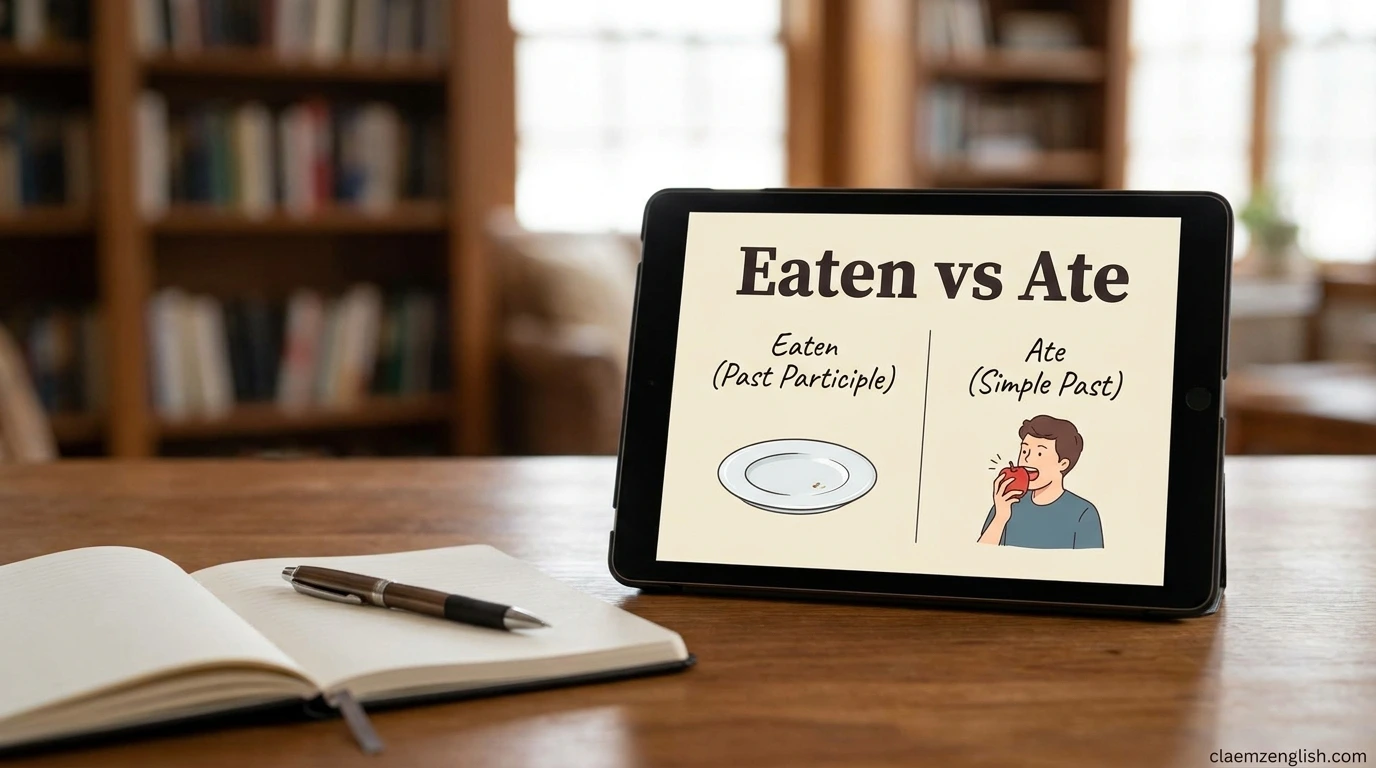
Many English learners—and even native speakers—get confused by eaten vs ate because both words come from the same verb: eat. They have similar meanings, but they are not interchangeable. Using the wrong form can make your writing sound awkward, lower your exam scores, or create confusion in professional communication.
The good news is that the difference is actually simple once you understand how English verb tenses work. In this guide, you’ll learn when to use ate and when to use eaten, along with grammar rules, easy examples, common mistakes, pronunciation tips, and practical exercises. By the end, you’ll be able to use both words confidently in everyday conversations and writing.
Understanding the Meaning of Ate and Eaten
Both ate and eaten come from the verb eat, which means to consume food.
The three main forms of the verb are:
| Verb Form | Word | Example |
| Base Form | Eat | I eat breakfast every morning. |
| Past Simple | Ate | I ate breakfast at 8 a.m. |
| Past Participle | Eaten | I have eaten breakfast already. |
The important thing to remember is:
- Ate is the simple past tense.
- Eaten is the past participle.
Although both refer to eating, they are used in different grammatical structures.
Quick Memory Trick
Think of it this way:
- Yesterday → Ate
- Have/Has/Had → Eaten
This simple rule solves most confusion.
Ate vs Eaten: What’s the Main Difference?
The biggest difference is grammar, not meaning.
| Ate | Eaten |
| Simple past tense | Past participle |
| Used alone | Used with helping verbs |
| Describes a completed action in the past | Used in perfect tenses and passive voice |
| “I ate lunch.” | “I have eaten lunch.” |
Examples
✅ I ate dinner at 7 o’clock.
✅ She ate an apple yesterday.
✅ We have eaten enough.
✅ They had eaten before we arrived.
Notice that eaten never stands alone as the main verb.
Incorrect:
❌ I eaten breakfast.
Correct:
✅ I have eaten breakfast.
When to Use “Ate”
Use ate when talking about something that happened and finished in the past.
It is the past tense of eat.
Structure
Subject + ate + object
Examples:
- I ate pizza yesterday.
- She ate breakfast before work.
- They ate all the cookies.
- We ate dinner together.
- My dog ate my homework.
Time Expressions Often Used with Ate
- Yesterday
- Last night
- Last week
- This morning
- An hour ago
- In 2023
Examples:
- We ate lunch yesterday.
- He ate too much last night.
- They ate at the new restaurant last weekend.
Correct Examples
✅ She ate an orange.
✅ We ate outside.
✅ I ate quickly because I was late.
Incorrect Examples
❌ She eaten an orange.
✅ She ate an orange.
When to Use “Eaten”
Eaten is the past participle.
It must be used with helping verbs such as:
- Have
- Has
- Had
- Have been
- Has been
- Had been
Structure
Subject + have/has/had + eaten
Examples:
- I have eaten breakfast.
- She has eaten already.
- They had eaten before the movie started.
Perfect Tenses
Present Perfect
- I have eaten lunch.
- She has eaten everything.
Past Perfect
- They had eaten before we arrived.
- He had eaten when I called.
Future Perfect
- By noon, I will have eaten.
- She will have eaten before the meeting.
Eaten in Passive Voice
Because eaten is a past participle, it is also used in passive sentences.
Examples:
- The cake was eaten by the children.
- All the food has been eaten.
- The cookies were eaten before dinner.
Grammar Rules You Should Know
Understanding the grammar behind ate and eaten makes choosing the correct word much easier.
Rule 1: Ate Never Needs a Helping Verb
Correct:
- I ate lunch.
- We ate together.
Incorrect:
- I have ate lunch.
- She has ate breakfast.
Instead, use:
- I have eaten lunch.
- She has eaten breakfast.
Rule 2: Eaten Always Needs a Helping Verb
Correct:
- I have eaten.
- They had eaten.
- She has eaten.
Incorrect:
- I eaten breakfast.
- We eaten dinner.
Rule 3: Don’t Mix Verb Forms
Incorrect:
- He has ate lunch.
Correct:
- He has eaten lunch.
Rule 4: Use Ate with Finished Past Time
Correct:
- I ate dinner yesterday.
- She ate lunch last Friday.
Rule 5: Use Eaten When the Time Is Not Important
Correct:
- I have eaten there before.
- She has eaten sushi many times.
The exact time doesn’t matter.
Comparison Table: Ate vs Eaten
| Feature | Ate | Eaten |
| Verb Form | Past tense | Past participle |
| Used Alone | Yes | No |
| Needs Helping Verb | No | Yes |
| Used in Perfect Tenses | No | Yes |
| Used in Passive Voice | No | Yes |
| Example | I ate lunch. | I have eaten lunch. |
Sentence Examples for Everyday English
Seeing real examples makes grammar easier to remember.
Using Ate
- I ate breakfast at home.
- She ate all the popcorn.
- We ate at an Italian restaurant.
- They ate too quickly.
- He ate before school.
Using Eaten
- I have eaten already.
- She has eaten dinner.
- They had eaten before leaving.
- We have eaten here many times.
- The cake has been eaten.
Conversation Examples
Person A: Have you eaten?
Person B: Yes, I have eaten already.
Person A: What did you do yesterday?
Person B: I ate dinner with my grandparents.
Person A: Is there any cake left?
Person B: No, it has been eaten.
Common Mistakes Learners Make
Many English learners make the same mistakes repeatedly.
Mistake 1
❌ I have ate breakfast.
✅ I have eaten breakfast.
Mistake 2
❌ She eaten lunch.
✅ She ate lunch.
OR
✅ She has eaten lunch.
Mistake 3
❌ We had ate before the movie.
✅ We had eaten before the movie.
Mistake 4
❌ They have ate all the pizza.
✅ They have eaten all the pizza.
Mistake 5
❌ Have you ate yet?
✅ Have you eaten yet?
Mistake 6
❌ I eaten already.
✅ I have eaten already.
Mistake 7
❌ Has she ate dinner?
✅ Has she eaten dinner?
Pronunciation Guide
Correct pronunciation helps you sound more natural.
| Word | Pronunciation | Sounds Like |
| Eat | /iːt/ | eet |
| Ate | /eɪt/ | eight |
| Eaten | /ˈiːtən/ | EE-tuhn |
Tips
- “Ate” rhymes with late, gate, and eight.
- “Eaten” has two syllables: EE-tuhn.
Practice:
- I ate lunch.
- I have eaten lunch.
Read both aloud to hear the difference.
British vs American English
The good news is that there is no difference between British and American English for these verb forms.
Both varieties use:
- Eat
- Ate
- Eaten
Examples in both dialects:
- I ate breakfast.
- I have eaten breakfast.
The grammar rules remain exactly the same.
The only differences you might notice are pronunciation or vocabulary surrounding meals (for example, “tea” meaning dinner in some parts of the UK), but ate and eaten never change.
Easy Tips to Remember the Difference
These simple tricks can help you avoid mistakes.
Tip 1
If you see:
- Have
- Has
- Had
- Will have
Use eaten.
Examples:
- Have eaten
- Has eaten
- Had eaten
Tip 2
If you’re talking about yesterday or another finished time, use ate.
Examples:
- Ate yesterday
- Ate last week
- Ate this morning
Tip 3
Never write:
- Have ate
- Has ate
- Had ate
These combinations are always incorrect.
Tip 4
Ask yourself:
Is there a helping verb?
If yes → eaten
If no → ate
Practice Quiz
Choose the correct answer.
1.
I _____ breakfast at 8 a.m.
A. eaten
B. ate
Answer:
✅ B. ate
2.
She has _____ already.
A. ate
B. eaten
Answer:
✅ B. eaten
3.
They _____ dinner before leaving.
A. had eaten
B. had ate
Answer:
✅ A. had eaten
4.
We _____ pizza yesterday.
A. ate
B. eaten
Answer:
✅ A. ate
5.
Have you _____ lunch yet?
A. ate
B. eaten
Answer:
✅ B. eaten
FAQs
Is “I have ate” correct?
No.
Correct:
- I have eaten.
Can I say “I eaten”?
No.
You need a helping verb.
Correct:
- I have eaten.
- I had eaten.
Is “ate” present tense?
No.
“Ate” is the simple past tense.
The present tense is:
- Eat
- Eats
Why is “eaten” called a past participle?
Because it is used with helping verbs to form perfect tenses and passive voice.
Examples:
- Have eaten
- Had eaten
- Has been eaten
Which word is more common?
Both are common.
Use:
- Ate for completed past actions.
- Eaten in perfect tenses and passive sentences.
Is “Have you ate?” correct?
No.
Correct:
- Have you eaten?
Can “eaten” be used without “have”?
Usually no.
It can also follow other helping verbs, such as:
- Had eaten
- Has been eaten
- Will have eaten
But it should not stand alone.
Final Summary and Conclusion
Understanding the difference between ate and eaten becomes easy once you remember their grammatical roles. Ate is the simple past tense, used for actions that happened and finished at a specific time in the past, such as “I ate breakfast yesterday.” Eaten is the past participle, which must be used with helping verbs like have, has, had, or will have, as in “I have eaten breakfast.” It also appears in passive constructions like “The cake was eaten.”
To remember the rule, think “Yesterday = ate” and “Have/Has/Had = eaten.” Avoid incorrect combinations like “have ate” or “I eaten”, and instead choose the form that matches the sentence structure. With regular practice and attention to helping verbs, you’ll use ate and eaten naturally in conversations, school assignments, exams, and professional writing. Mastering this small grammar point will make your English clearer, more accurate, and more confident.
