
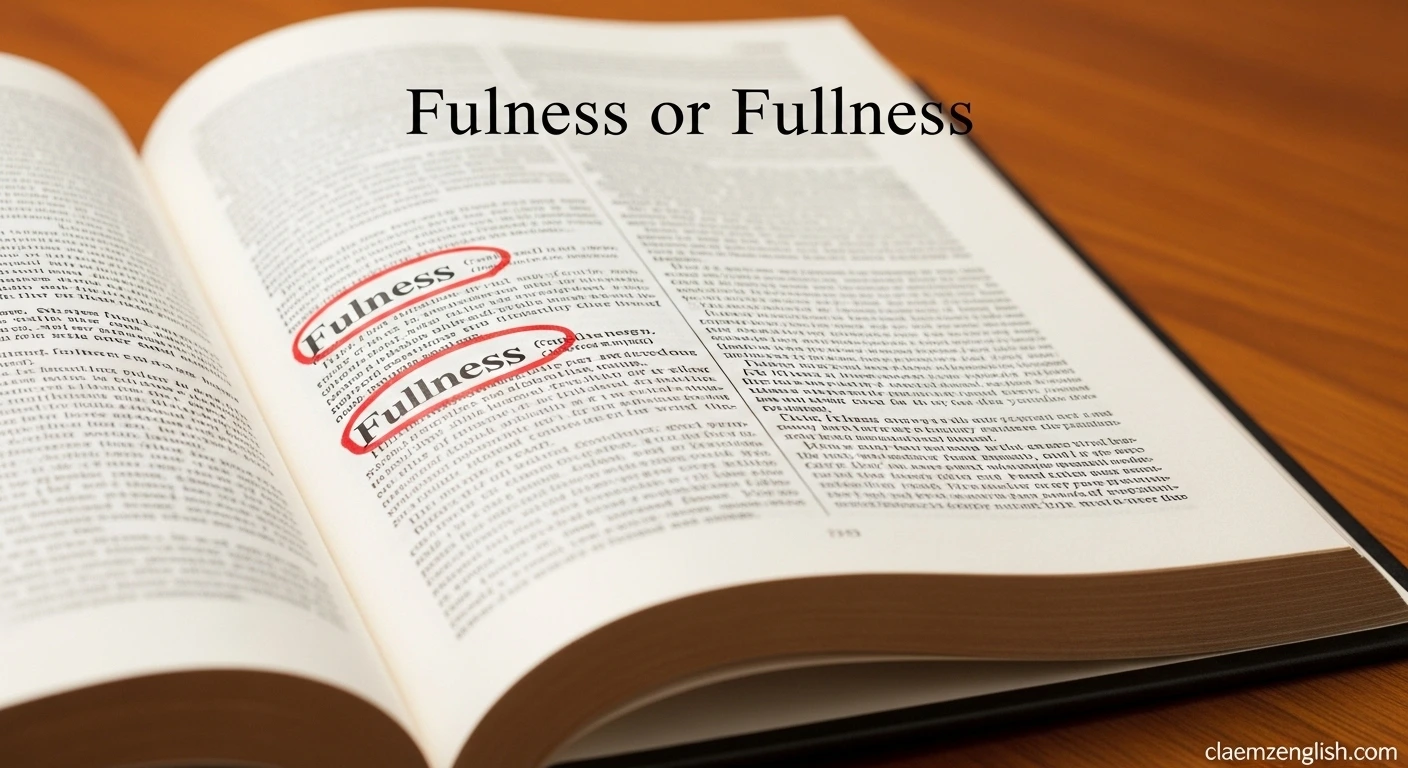
People often get confused between “fulness” and “fullness”, especially when writing quickly, relying on memory, or learning English as a second language. At first glance, both look similar, and both seem like they could be correct. However, only one of them is accepted in modern English usage.
This small spelling difference matters more than it seems. In exams, professional writing, emails, academic essays, and even job applications, using the wrong form can make your writing look careless or outdated. English learners especially struggle with double letters and suffix rules like “-ness,” which leads to confusion between forms such as fullness, happiness, or sadness.
In this article, we will clearly explain why “fullness” is correct, why “fulness” is considered incorrect in modern English, and how you can confidently remember the right spelling. We will also explore pronunciation, word formation rules, real-life examples, and common mistakes to help you master this term once and for all.
What Do “Fulness” and “Fullness” Mean?
Before comparing spelling, it is important to understand the meaning of the word itself.
Fullness refers to:
- A state of being full or complete
- A feeling of satisfaction or satiety (especially after eating)
- A sense of richness, abundance, or completeness
- Emotional or physical wholeness
For example:
- She felt a sense of fullness after the meal.
- The fullness of the sound filled the room.
- His life reached a fullness he had never experienced before.
Now what about “fulness”?
In modern English, “fulness” is generally considered a misspelling of fullness. It does not appear in standard dictionaries as a correct modern form, except in rare historical or archaic usage (which we will discuss later).
Quick Meaning Comparison Table
| Word | Status | Meaning | Usage Today |
| Fullness | Correct | State of being full, complete, or satisfied | Common and standard |
| Fulness | Incorrect (modern usage) | Same meaning historically intended | Rare/archaic, not recommended |
Why “Fullness” Is the Correct Spelling
The correct spelling is fullness because it follows standard English word formation rules.
The base word is:
- full (adjective)
When we add the suffix:
- -ness (used to form nouns from adjectives)
We get:
- full + -ness = fullness
One important spelling rule in English is:
When an adjective ends in a consonant-vowel-consonant pattern or has a double letter, we often preserve the base form when adding suffixes.
Since full already ends with a double “l,” we simply add “-ness” without removing or changing letters.
Why “fulness” looks wrong
The spelling fulness removes one “l” from the base word “full.” This breaks the structure of the root word and does not follow standard derivational rules in modern English.
Origin and Word Formation (Full + -ness)
Understanding word formation helps you avoid spelling mistakes permanently.
The suffix “-ness” is used to turn adjectives into nouns that describe a state or quality.
Examples of adjective → noun formation:
| Adjective | Noun with -ness | Meaning |
| full | fullness | state of being full |
| happy | happiness | state of joy |
| dark | darkness | absence of light |
| kind | kindness | quality of being kind |
| aware | awareness | state of being aware |
Notice a pattern:
- The root adjective remains unchanged (mostly)
- The suffix “-ness” is added directly
- No letters are removed unless required by spelling rules
So:
- ❌ ful + ness = fulness (incorrect)
- ✅ full + ness = fullness (correct)
Is “Fulness” Ever Acceptable? Historical Usage
You may sometimes see “fulness” in older religious texts, poetry, or historical documents. This is because English spelling was not standardized in earlier centuries.
In Middle and Early Modern English:
- Spelling was flexible
- Writers often used different forms of the same word
- “Fulness” was occasionally used as an alternative spelling of “fullness”
However, modern English has standardized spelling rules, and dictionaries, academic institutions, and publishing standards all recognize “fullness” only.
Important note:
- “Fulness” is considered archaic
- It is not accepted in academic, professional, or formal writing today
Usage timeline comparison
| Time Period | Spelling Used | Status Today |
| Before 18th century | fulness / fullness | Both used |
| Modern English | fullness | Standard |
| Today (formal writing) | fulness | Incorrect |
British vs American English Usage
Unlike some spelling differences such as colour/color or realise/realize, there is no British vs American difference in this case.
Both:
- British English
- American English
use the same correct spelling:
fullness
Key takeaway:
- There is no regional variation
- Any form without double “l” is incorrect everywhere today
Comparison Table: Regional Usage
| Variant | British English | American English | Correct? |
| fullness | ✔ correct | ✔ correct | Yes |
| fulness | ✘ incorrect | ✘ incorrect | No |
Pronunciation Guide
Another reason learners get confused is pronunciation. The word sounds simple, but spelling errors happen due to its structure.
Pronunciation of “fullness”:
- Phonetic: /ˈfʊl.nəs/
- Sounds like: full-ness
Break it down:
- “full” → like “pull” with an F
- “ness” → soft ending like “happiness”
Important tip:
Even though we pronounce only one clear “l” sound, the spelling still keeps the double “l” from the base word “full.”
This mismatch between pronunciation and spelling is a common reason for mistakes.
Common Mistakes Learners Make
Many English learners mistakenly write fulness instead of fullness. Let’s look at why this happens.
1. Dropping double letters
Learners often assume double consonants are unnecessary.
Incorrect:
- ❌ fulness
Correct: - ✅ fullness
2. Writing based on sound
Because “fullness” is pronounced quickly, the double “l” is not clearly heard.
3. Confusion with similar words
| Incorrect Form | Correct Form | Reason for Error |
| fulness | fullness | missing double “l” |
| greatfulness | gratefulness | wrong base word |
| helpfullness | helpfulness | double “l” rule confusion |
4. Overgeneralizing spelling rules
Learners assume all suffix forms simplify the root word, which is not true.
Correct vs Incorrect Examples
Let’s make the difference crystal clear with real-life examples.
Sentence Examples Table
| Incorrect Sentence | Correct Sentence |
| She felt fulness after eating. | She felt fullness after eating. |
| The room had a sense of fulness. | The room had a sense of fullness. |
| His life reached fulness. | His life reached fullness. |
| I experienced emotional fulness. | I experienced emotional fullness. |
| The fulness of the glass surprised me. | The fullness of the glass surprised me. |
Additional usage examples (correct only)
- The fullness of her voice was powerful.
- He appreciated the fullness of the experience.
- The fullness of time revealed the truth.
- The meal gave him a feeling of fullness and comfort.
Related Words and Spelling Patterns
Understanding related words helps reinforce correct spelling.
Word family of “full”:
| Base Word | Derived Form | Meaning |
| full | fullness | state of being full |
| full | fully | completely |
| full | fulfill | to complete a task |
| full | fruitful | productive (related idea of fullness of results) |
Key spelling insight:
- Words derived from “full” usually preserve the double “l”
- This is a consistent spelling pattern in modern English
FAQs About “Fulness” vs “Fullness”
1. Is “fulness” ever correct?
No, in modern English it is considered incorrect. It may appear in very old texts but should not be used today.
2. Why do people still write “fulness”?
Because they assume English words simplify when adding suffixes, or they are influenced by pronunciation.
3. What is the correct spelling in exams?
Always write fullness. “Fulness” will likely be marked wrong.
4. Is there any difference in meaning?
No difference in meaning exists. The only issue is spelling correctness.
5. How can I remember the correct spelling?
Remember:
full + ness = fullness
Keep the double “l” from “full.”
6. Is “fullness” formal or informal?
It is neutral and can be used in all contexts:
- Academic writing
- Professional communication
- Everyday conversation
Conclusion
The confusion between “fulness” and “fullness” is common, but the rule is simple and important:
The correct modern English spelling is fullness.
The form “fulness” is outdated and incorrect in today’s standard English. It occasionally appears in historical texts, but it should not be used in exams, academic writing, business communication, or professional content.
By understanding the word’s structure (full + -ness), pronunciation, and spelling rules, you can easily avoid this mistake in the future. Remember that English often preserves base word spelling when adding suffixes, especially when double letters are involved.
Final takeaway:
- ✔ Fullness = correct
- ✘ Fulness = incorrect
Mastering small spelling differences like this improves your writing accuracy, boosts your confidence, and helps you communicate more professionally in English.
