
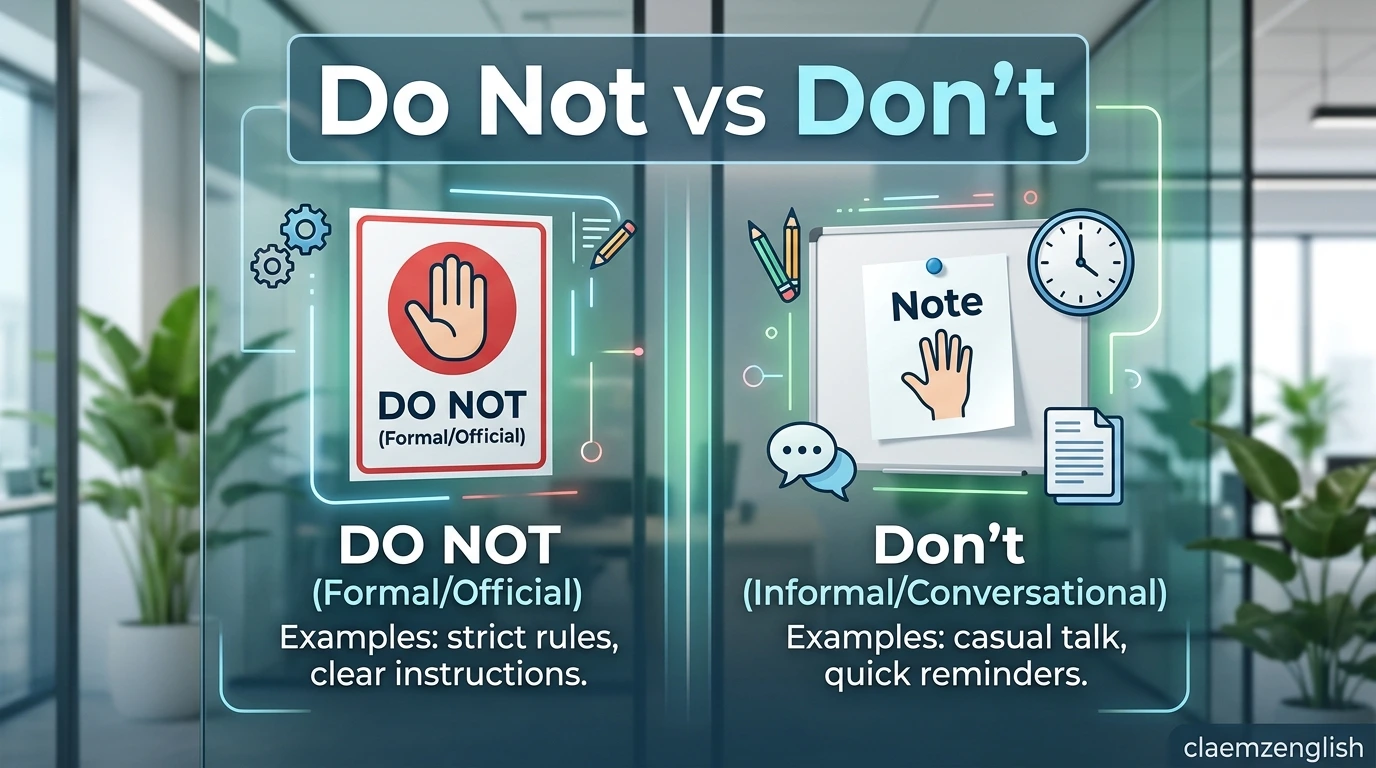
Have you ever wondered whether you should write do not or don’t? Many English learners, students, and even native speakers get confused about when to use the full form and when the contraction is more appropriate. Although both expressions have the same meaning, they create different tones and are used in different situations.
Knowing the difference matters because it can improve your writing, make your speech sound more natural, and help you choose the right style for school assignments, business emails, professional communication, exams, and everyday conversations. Once you understand the simple rules, you’ll know exactly which form fits every situation.
In this guide, you’ll learn the meaning of do not vs don’t, their grammar rules, pronunciation, correct usage, common mistakes, practical examples, and easy tips to remember the difference.
What Do “Do Not” and “Don’t” Mean?
Both do not and don’t express negation. They tell someone not to do something, deny an action, or indicate that something is untrue.
- Do not = the full form
- Don’t = the contracted (shortened) form of do not
Both have exactly the same grammatical meaning.
Examples
- Do not open the door.
- Don’t open the door.
Both sentences mean the same thing. The only difference is the level of formality.
Quick Comparison
| Feature | Do Not | Don’t |
| Meaning | Negative form of “do” | Short form of “do not” |
| Formality | Formal | Informal |
| Common in speech | Less common | Very common |
| Common in writing | Formal writing | Everyday writing |
| Grammar | Correct | Correct |
The choice depends on style, tone, and audience, not grammar.
When Should You Use “Do Not”?
Do not is the complete, formal version. It sounds stronger, clearer, and more serious than don’t.
Use do not in situations such as:
- Academic essays
- Formal letters
- Business documents
- Official notices
- Contracts
- Legal writing
- Instructions requiring emphasis
- Exams requiring formal English
Examples
- Do not enter this area.
- Please do not smoke inside the building.
- Students must do not… ❌
- Students should not cheat during examinations. ✅
- Do not forget to submit your assignment.
When “Do Not” Adds Emphasis
Sometimes writers intentionally use do not to make a sentence stronger.
Example:
I do not agree with that decision.
This sounds firmer than:
I don’t agree with that decision.
Both are correct, but the full form emphasizes disagreement.
Common Formal Situations
- Warning signs
- School instructions
- Employee manuals
- Research papers
- Government notices
- Professional reports
When Should You Use “Don’t”?
Don’t is simply a contraction of do not. Native speakers use it constantly in everyday conversation because it’s quicker and sounds natural.
Use don’t when speaking casually or writing informally.
Everyday Examples
- Don’t worry.
- I don’t know.
- Don’t be late.
- We don’t have enough time.
- They don’t like spicy food.
Informal Writing
You can safely use don’t in:
- Text messages
- Social media
- Blogs
- Friendly emails
- Personal journals
- Casual conversations
Examples
- Don’t forget your keys.
- I don’t watch much television.
- We don’t live here anymore.
- Don’t touch that!
- They don’t understand the question.
Using don’t makes writing sound friendly and conversational.
Do Not vs Don’t: Side-by-Side Comparison
Understanding the differences becomes much easier when you compare both forms directly.
| Situation | Do Not | Don’t |
| Formal report | ✅ Best choice | ❌ Usually avoided |
| Business email | ✅ Appropriate | ⚠ Sometimes acceptable if casual |
| Legal document | ✅ Preferred | ❌ Avoid |
| Classroom essay | ✅ Better | ⚠ Depends on teacher |
| Friendly email | ⚠ Acceptable | ✅ Preferred |
| Conversation | ⚠ Less common | ✅ Natural |
| Text message | ❌ Unusual | ✅ Very common |
| Social media | ⚠ Rare | ✅ Common |
Key Point
Neither expression is more grammatically correct.
The difference is simply:
- Do not = formal
- Don’t = informal
Grammar Rules for “Do Not” and “Don’t”
Both expressions follow the same grammar because don’t is only a shortened version of do not.
Rule 1: Use with Base Verbs
Correct:
- Do not eat.
- Don’t eat.
- Do not run.
- Don’t run.
Rule 2: Use with “I, You, We, They”
Examples:
- I do not understand.
- I don’t understand.
- They do not agree.
- They don’t agree.
Rule 3: Questions Use “Do”
Question:
- Do you like coffee?
Negative answer:
- No, I do not.
- No, I don’t.
Both are correct.
Rule 4: Negative Commands
Correct:
- Do not park here.
- Don’t park here.
Rule 5: Never Double Negatives
Incorrect:
❌ I don’t know nothing.
Correct:
✅ I don’t know anything.
or
✅ I know nothing.
Pronunciation: How Are They Spoken?
Although they have the same meaning, their pronunciation is different.
| Expression | Approximate Pronunciation | Natural Speech |
| Do not | doo not | Clear and deliberate |
| Don’t | dohnt | Faster and smoother |
Native speakers usually pronounce don’t because contractions make speech flow naturally.
Spoken English
More natural:
- I don’t know.
- We don’t care.
- Don’t worry.
Less common in conversation:
- I do not know.
- We do not care.
The full form usually appears when someone wants to sound serious or emphasize a point.
Example:
“I do not believe that.”
Common Mistakes and How to Avoid Them
Many learners misuse do not and don’t because they mix formal and informal writing.
Mistake 1: Using “Don’t” in Formal Essays
Incorrect (formal essay):
Students don’t always complete assignments.
Better:
Students do not always complete assignments.
Mistake 2: Using “Do Not” in Casual Texting
Unnatural:
Do not forget dinner.
More natural:
Don’t forget dinner.
Mistake 3: Incorrect Verb Form
Incorrect:
❌ Don’t goes there.
Correct:
✅ Don’t go there.
After do not or don’t, always use the base form of the verb.
Mistake 4: Missing Apostrophe
Incorrect:
❌ Dont worry.
Correct:
✅ Don’t worry.
The apostrophe replaces the missing letters in not.
Mistake 5: Double Negatives
Incorrect:
❌ We don’t need no help.
Correct:
✅ We don’t need any help.
Real-Life Sentence Examples
Here are practical examples that show when each form sounds best.
Formal Examples
- Do not leave valuables unattended.
- Please do not interrupt the speaker.
- Employees do not have permission to enter this area.
- Do not remove this label.
- Visitors do not need special permission.
Informal Examples
- Don’t forget your wallet.
- I don’t feel well today.
- We don’t eat meat.
- They don’t play football anymore.
- Don’t be afraid.
Correct vs Incorrect Examples
| Incorrect | Correct |
| Dont forget. | Don’t forget. |
| Don’t goes there. | Don’t go there. |
| Do not goes outside. | Do not go outside. |
| I don’t know nothing. | I don’t know anything. |
| She don’t like coffee. | She doesn’t like coffee. |
Notice that she, he, and it require doesn’t, not don’t.
Examples:
✅ She doesn’t agree.
❌ She don’t agree.
Easy Tips to Remember the Difference
You don’t need to memorize complicated grammar rules. Just remember these simple tips.
Use “Do Not” When:
- Writing formal documents
- Completing school assignments
- Preparing reports
- Writing official letters
- Giving serious warnings
- Adding emphasis
Use “Don’t” When:
- Talking with friends
- Sending text messages
- Writing blogs
- Posting on social media
- Having everyday conversations
- Writing casual emails
Memory Trick
Think of it this way:
- Do not = Professional
- Don’t = Personal
That simple rule works in most situations.
FAQs
Is “don’t” grammatically correct?
Yes. Don’t is a standard English contraction of do not and is completely grammatically correct.
Is “do not” more polite?
Not necessarily. It is more formal and sometimes sounds stronger or more serious.
Can I use “don’t” in academic writing?
Many teachers prefer do not in formal essays because contractions can sound too conversational. Always follow your instructor’s style requirements.
Is there a meaning difference between “do not” and “don’t”?
No. Both mean exactly the same thing. The difference is only in tone and formality.
Which one is more common in everyday English?
Don’t is much more common in spoken English and informal writing.
Do British and American English use them differently?
No. Both British and American English use do not and don’t in the same way. The difference is based on formality rather than regional English.
Why is there an apostrophe in “don’t”?
The apostrophe shows that letters have been removed from do not. It replaces the missing o in not when the words are contracted.
Conclusion
Understanding do not vs don’t is much easier than it first appears. Both expressions have the same meaning and are grammatically correct, but they serve different purposes depending on the situation.
Choose do not when writing formally, creating professional documents, or adding emphasis to an important statement. Choose don’t when speaking naturally, chatting with friends, writing informal emails, or communicating in everyday situations.
A simple rule to remember is this:
- Formal writing → Do not
- Casual conversation → Don’t
Once you become familiar with the tone of each form, choosing the right one becomes automatic. Whether you’re preparing for an exam, improving your grammar, writing professionally, or simply speaking more naturally, mastering this small distinction will make your English clearer, more confident, and more effective.
