
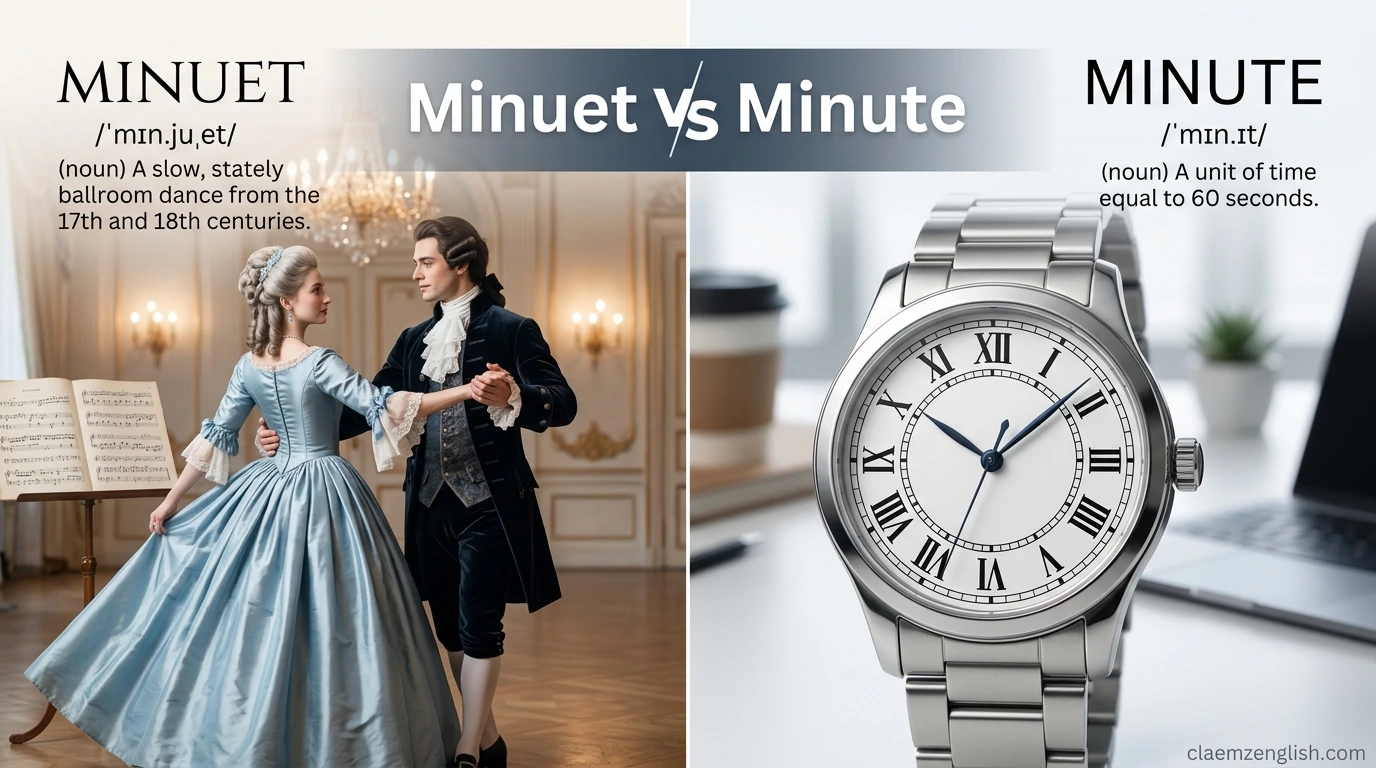
Have you ever read the words minuet and minute and wondered whether they were related? They look almost identical, but they have completely different meanings and pronunciations. This similarity causes confusion for students, English learners, writers, and even native speakers.
Understanding the difference between minuet vs minute is important because using the wrong word can completely change the meaning of your sentence. Whether you’re writing an essay, sending an email, preparing for an English exam, or simply improving your vocabulary, knowing when to use each word will make your communication more accurate and professional.
This guide explains everything you need to know in simple English. You’ll learn the meanings, pronunciation, grammar rules, spelling differences, common mistakes, real-life examples, and practical memory tricks so you’ll never confuse these two words again.
What Do “Minuet” and “Minute” Mean?
Although they differ by only one letter, these words belong to completely different categories.
| Word | Part of Speech | Meaning | Pronunciation |
| Minuet | Noun | A slow, graceful dance popular in the 17th and 18th centuries | min-yoo-ET |
| Minute | Noun | A unit of time equal to 60 seconds | MIN-it |
| Minute | Adjective | Extremely small or tiny | my-NOOT (US), my-NYOOT (UK) |
The key point is that minute actually has two common meanings, while minuet has only one.
Minuet
A minuet is a formal ballroom dance that became popular in Europe, especially in France, during the Baroque period. It is also a style of music written for that dance.
Examples:
- The dancers performed a beautiful minuet.
- The orchestra played a Mozart minuet.
- They practiced the royal minuet before the performance.
Minute (Time)
The most common meaning of minute is a measurement of time.
Examples:
- Wait one minute.
- The meeting lasted thirty minutes.
- She arrived five minutes early.
Minute (Very Small)
As an adjective, minute means extremely tiny or very detailed.
Examples:
- Scientists discovered minute particles.
- There was only a minute difference between the results.
- The inspector noticed minute cracks in the wall.
Minuet vs Minute: Side-by-Side Comparison
The easiest way to understand these words is to compare them directly.
| Feature | Minuet | Minute |
| Meaning | A classical dance | A unit of time or extremely small |
| Part of Speech | Noun | Noun or adjective |
| Common Use | Music and dance | Everyday conversation |
| Pronunciation | min-yoo-ET | MIN-it (noun), my-NOOT (adjective) |
| Frequency | Rare | Very common |
Quick Summary
Choose minuet when talking about:
- Classical dance
- Classical music
- Historical performances
- Ballroom traditions
Choose minute when talking about:
- Time
- Small details
- Tiny objects
- Measurements
Pronunciation Differences
One major reason people confuse these words is because their spellings are so similar. Fortunately, their pronunciations are very different.
| Word | IPA | Easy Pronunciation |
| Minuet | /ˌmɪn.juˈet/ | min-yoo-ET |
| Minute (noun) | /ˈmɪn.ɪt/ | MIN-it |
| Minute (adjective US) | /maɪˈnuːt/ | my-NOOT |
| Minute (adjective UK) | /maɪˈnjuːt/ | my-NYOOT |
Notice how the stress changes.
- MIN-it = time
- my-NOOT = tiny
- min-yoo-ET = dance
Listen for the Stress
Correct:
- One MIN-it
- A my-NOOT detail
- A graceful min-yoo-ET
Changing the stress changes the meaning.
When to Use “Minuet”
Because minuet is uncommon in modern daily conversation, many learners never encounter it until reading literature, music history, or historical fiction.
Use minuet when discussing:
- Classical dance
- Ballet
- Music history
- European culture
- Baroque compositions
Examples
- The prince invited the princess to dance a minuet.
- Every student learned the traditional minuet.
- Mozart composed several elegant minuets.
- The ballroom echoed with the sound of a royal minuet.
- The dancers bowed before beginning the minuet.
Plural Form
Singular:
- minuet
Plural:
- minuets
Examples:
- The concert included three minuets.
- The dancers performed several minuets.
When to Use “Minute”
Unlike minuet, the word minute appears in everyday English.
It has two separate meanings.
Minute as a Noun
This means 60 seconds.
Examples:
- Give me a minute.
- The movie starts in ten minutes.
- She waited for twenty minutes.
- Every minute counts.
- The race finished in less than one minute.
Minute as an Adjective
This means extremely small.
Examples:
- The microscope revealed minute organisms.
- We noticed minute differences.
- There were minute cracks in the glass.
- The lawyer examined every minute detail.
- Scientists measured minute particles.
Grammar Rules and Correct Usage
Understanding grammar helps prevent confusion.
Rule 1: Minuet Is Always a Noun
Correct:
- They danced a minuet.
Incorrect:
- The crack was minuet.
Why?
A dance cannot describe size.
Rule 2: Minute Can Be a Noun
Correct:
- Wait one minute.
Incorrect:
- Wait one minuet.
Rule 3: Minute Can Be an Adjective
Correct:
- A minute amount of dust.
Incorrect:
- A minuet amount of dust.
Rule 4: Check the Context
Ask yourself:
Is the sentence about:
- Time?
- Small size?
Use minute.
Is it about:
- Dancing?
- Classical music?
Use minuet.
Correct vs Incorrect Examples
Seeing mistakes side by side makes learning much easier.
| Correct | Incorrect | Why |
| Wait one minute. | Wait one minuet. | Talking about time |
| They danced a minuet. | They danced a minute. | Talking about a dance |
| The difference is minute. | The difference is minuet. | Means very small |
| The orchestra played a minuet. | The orchestra played a minute. | Musical composition |
| She arrived five minutes early. | She arrived five minuets early. | Time measurement |
More Correct Sentences
- We only have a few minutes left.
- The dancers rehearsed the minuet.
- Every minute matters.
- Scientists observed minute organisms.
- The concert ended with a lively minuet.
Common Mistakes People Make
Because the spellings are almost identical, writers often mix them up.
Mistake 1: Using “Minuet” for Time
Incorrect:
I’ll be there in five minuets.
Correct:
I’ll be there in five minutes.
Mistake 2: Forgetting the Adjective Meaning of Minute
Incorrect:
The difference is very minuet.
Correct:
The difference is minute.
Mistake 3: Mispronouncing Minute
Many learners pronounce every form the same way.
Remember:
- MIN-it = time
- my-NOOT = tiny
Mistake 4: Assuming the Words Are Related
Although they look alike, they come from different origins and have different meanings.
Never substitute one for the other.
Mistake 5: Spelling Errors
People sometimes write:
- minuite
- minuite
- minuet (when they mean minute)
Always double-check the spelling.
Easy Memory Tricks
Simple memory tricks make these words easy to remember.
Trick 1: Think of Music
Minuet ends with -et, like a French dance.
Dance = Minuet
Trick 2: Think of Time
Every clock measures minutes.
Clock = Minute
Trick 3: Think Small
The adjective minute means something so small that it almost takes a microscope to see.
Tiny = Minute
Trick 4: Ask Yourself a Question
Is the sentence about:
- Time?
- Size?
Use minute.
Is it about:
- Dancing?
- Classical music?
Use minuet.
Real-Life Examples
Here are examples you’ll encounter in everyday English.
In School
- We have one minute left before class ends.
- The history lesson discussed the minuet.
At Work
- I’ll finish this report in ten minutes.
- We noticed a minute error in the document.
In Music
- Mozart wrote several famous minuets.
- The orchestra performed a beautiful minuet.
In Science
- The microscope revealed minute bacteria.
- Researchers measured minute particles.
In Conversation
- Give me a minute.
- Just one minute, please.
British vs American English
The meanings of minuet and minute are the same in both British and American English. However, there is a slight pronunciation difference for minute when used as an adjective.
| Usage | American English | British English |
| Minute (time) | MIN-it | MIN-it |
| Minute (tiny) | my-NOOT | my-NYOOT |
| Minuet | min-yoo-ET | min-yoo-ET |
The spelling remains identical in both varieties of English.
FAQs
Is “minuet” another spelling of “minute”?
No.
They are completely different words with different meanings and pronunciations.
Which word means 60 seconds?
Minute.
Example:
- The train leaves in one minute.
Which word refers to a classical dance?
Minuet.
Example:
- They performed a traditional minuet.
Can “minute” mean tiny?
Yes.
When used as an adjective, minute means extremely small.
Example:
- A minute scratch covered the surface.
Is “minuet” commonly used today?
Not in everyday conversation.
You’ll mainly find it in:
- Music
- Dance
- History
- Literature
- Classical performances
Why do people confuse these words?
Because:
- They look almost identical.
- They differ by only one letter.
- Many learners have never seen minuet before.
- The adjective minute has a different pronunciation from the noun.
How can I remember the difference?
Remember this simple rule:
- Minute = time or tiny.
- Minuet = dance.
If no one is dancing, you almost certainly need minute.
Conclusion
The difference between minuet vs minute becomes simple once you focus on meaning and pronunciation rather than spelling alone.
- Minuet is a noun referring to a graceful classical dance or the music written for it.
- Minute is far more common and means either a unit of time (60 seconds) or extremely small when used as an adjective.
A quick way to remember is this: clocks measure minutes, dancers perform minuets, and tiny details are minute. Before choosing the word, ask yourself whether you’re talking about time, size, or a dance. With that simple check, you’ll use the correct word confidently in conversations, writing, exams, and professional communication every time.
