
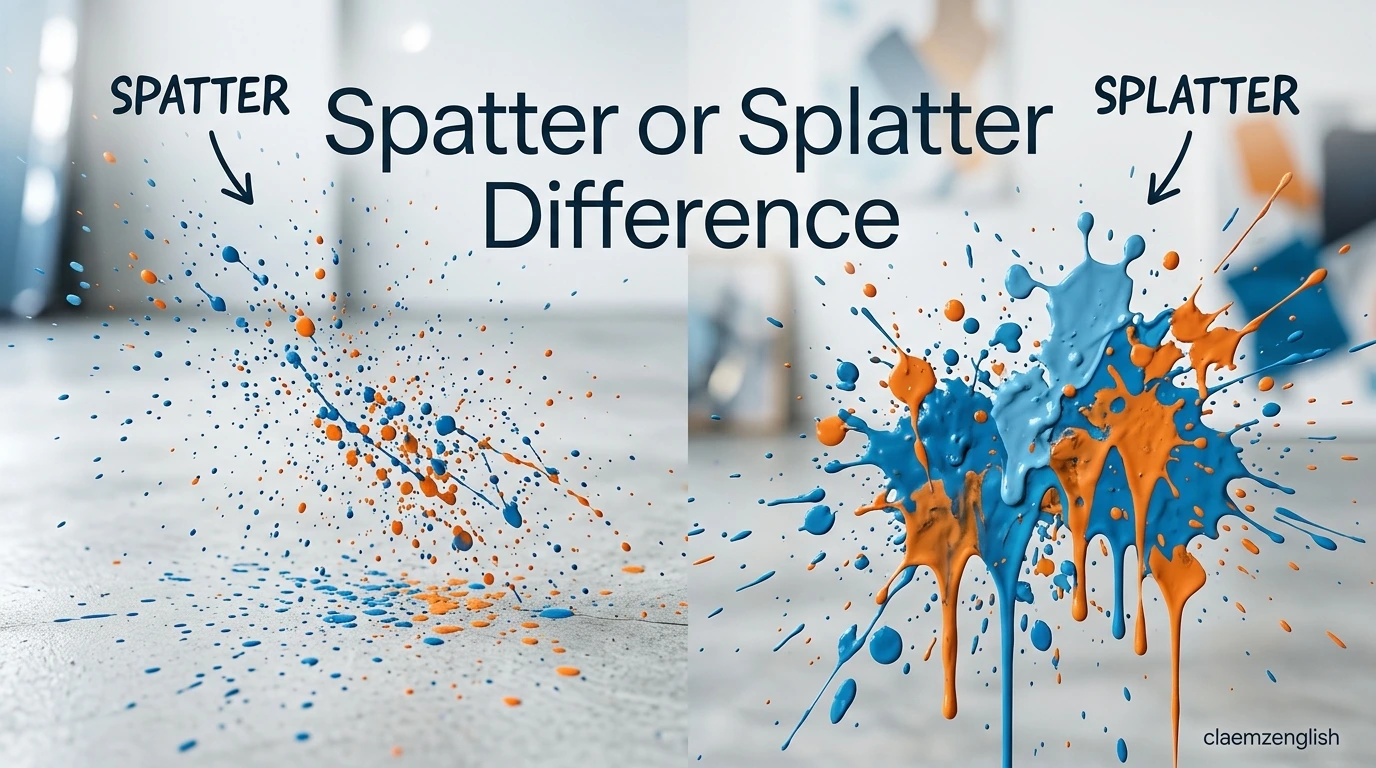
When writing or speaking English, many people wonder whether they should use spatter or splatter. These two words look almost identical, sound very similar, and often appear in the same situations. Because of this, students, writers, professionals, and English learners frequently mix them up.
Understanding the spatter or splatter difference is important because choosing the right word makes your writing more accurate and natural. Whether you’re describing paint on a wall, mud on a car, blood in a crime novel, or sauce in the kitchen, knowing which word fits the situation helps you communicate clearly.
In this complete guide, you’ll learn the meanings of spatter and splatter, discover when each word is correct, explore spelling and pronunciation differences, study grammar rules, and review plenty of practical examples. By the end, you’ll remember the difference with confidence.
What Do Spatter and Splatter Mean?
Both spatter and splatter describe liquid or small particles hitting a surface. However, there is a subtle difference in how English speakers usually use them.
Spatter Meaning
Spatter generally refers to small drops scattered lightly over a surface. The action is often gentle or moderate.
Examples include:
- Rain spattered against the window.
- Paint spattered onto the newspaper.
- Tiny drops of oil spattered from the frying pan.
The emphasis is on small scattered drops.
Splatter Meaning
Splatter usually refers to larger, heavier, or messier drops that spread when they hit something.
Examples include:
- Mud splattered all over the truck.
- Tomato sauce splattered across the kitchen wall.
- The child splattered paint across the canvas.
The emphasis is on a bigger, messier splash.
Quick Comparison
| Feature | Spatter | Splatter |
| Size of drops | Small | Larger |
| Amount | Light | Heavy |
| Messiness | Mild | More noticeable |
| Typical impression | Fine droplets | Big splashes |
| Common tone | Neutral | More dramatic |
Although these differences exist, many native speakers use the two words interchangeably in everyday conversation.
Spatter vs Splatter: The Main Difference
If you only remember one thing, remember this:
Spatter = small scattered drops.
Splatter = larger, messier splashes.
Imagine dropping two different amounts of paint.
If a paintbrush flicks tiny dots onto paper, that’s usually spatter.
If you throw an entire cup of paint against a wall, that’s splatter.
Visual Comparison
Think of these situations:
Spatter
- Light rain
- Small oil droplets
- Fine paint dots
- Tiny blood spots
Splatter
- Thick mud
- Large paint splash
- Sauce explosion
- Big puddle splash
The action becomes stronger and messier with splatter.
How to Use Spatter and Splatter Correctly
Both words work as verbs and nouns.
Spatter as a Verb
Meaning: to scatter small drops.
Examples:
- Rain spattered the windshield.
- The chef accidentally spattered oil onto the stove.
- Mud spattered my shoes.
Spatter as a Noun
Examples:
- A spatter of rain fell before sunset.
- There was a spatter of paint on the floor.
- The detective examined the blood spatter.
Notice that in forensic science, blood spatter is the standard technical term.
Splatter as a Verb
Meaning: to splash large drops.
Examples:
- The truck splattered mud everywhere.
- The child splattered paint on the wall.
- Sauce splattered onto my shirt.
Splatter as a Noun
Examples:
- There was a huge splatter of ketchup.
- The splatter covered half the table.
- Clean the splatter before it dries.
Grammar Rules and Word Forms
Understanding the grammar helps you use both words naturally.
Verb Forms
| Base Form | Past Tense | Past Participle | Present Participle |
| spatter | spattered | spattered | spattering |
| splatter | splattered | splattered | splattering |
Examples:
- Oil spattered across the stove.
- Mud splattered over the car.
- Water is spattering onto the floor.
- Paint is splattering everywhere.
Noun Forms
Both nouns can be singular or plural.
Examples:
Singular
- A spatter of rain
- A splatter of paint
Plural
- Several spatters appeared.
- Bright splatters covered the wall.
Spelling Differences and Why They Matter
The only spelling difference is one extra letter.
| Word | Spelling |
| Spatter | S-P-A-T-T-E-R |
| Splatter | S-P-L-A-T-T-E-R |
Notice that splatter includes “l” after sp.
Many learners accidentally spell:
❌ splater
Correct spelling:
✅ splatter
Likewise:
❌ spater
Correct spelling:
✅ spatter
Because the words are so similar, proofreading is helpful.
British vs American English
Unlike many English words, spatter and splatter are used in both British and American English.
Neither spelling changes between the two varieties.
However, usage preferences can vary.
American English
American speakers often use splatter in casual conversation because it sounds more expressive.
Examples:
- Splatter paint
- Splatter movie
- Mud splattered everywhere
British English
British speakers also use both words, although spatter sometimes appears more often in formal writing.
The meanings remain the same.
There is no British spelling difference such as changing “-er” to “-re.”
Pronunciation Guide
The pronunciation is almost identical except for the added L sound.
Spatter
Pronounced:
SPAT-er
Approximate pronunciation:
/ˈspætər/
Splatter
Pronounced:
SPLAT-er
Approximate pronunciation:
/ˈsplætər/
The only difference is hearing the “l” after sp.
Practice aloud:
- spatter
- splatter
- spatter
- splatter
After several repetitions, the distinction becomes much easier.
Real-Life Sentence Examples
Seeing words in context is the fastest way to remember them.
Spatter Examples
- Raindrops spattered against the windows.
- Paint spattered across the newspaper.
- Tiny drops of oil spattered onto the stove.
- Blood spatter helped investigators understand the scene.
- Mud lightly spattered my trousers.
- Coffee spattered onto my notebook.
- The artist liked the delicate spatter effect.
- Dust spattered across the shelf.
- Water spattered onto the pavement.
- Ink spattered over the paper.
Splatter Examples
- The truck splattered mud all over my clothes.
- The child splattered paint on every wall.
- Tomato soup splattered across the counter.
- The balloon splattered water everywhere.
- Waves splattered against the rocks.
- The blender splattered smoothie across the kitchen.
- The cyclist splattered through a puddle.
- Wet cement splattered onto the sidewalk.
- Chocolate splattered across the plate.
- The explosion splattered debris across the road.
Correct vs Incorrect Usage
These comparisons help avoid common mistakes.
| Correct | Incorrect | Why? |
| Tiny drops of rain spattered the glass. | Tiny drops of rain splattered the glass. | “Spatter” better matches fine droplets. |
| Thick mud splattered across the truck. | Thick mud spattered across the truck. | “Splatter” suggests a heavier mess. |
| The artist used a paint spatter effect. | The artist used a paint splatter effect. | Either may work, but “spatter” often refers to finer dots. |
| The child splattered paint everywhere. | The child spattered paint everywhere. | “Splatter” emphasizes a messy action. |
Remember that in many casual situations, native speakers may accept either word.
Common Mistakes Learners Make
Many English learners confuse these words in predictable ways.
1. Thinking They’re Completely Different
They are actually very closely related.
The difference is mostly about size, force, and messiness.
2. Using Splatter for Every Situation
Not every splash is dramatic.
Small droplets are usually better described as spatter.
3. Misspelling the Words
Wrong:
- splater
- spater
Correct:
- splatter
- spatter
4. Forgetting Technical Usage
In forensic science, the accepted expression is:
✅ blood spatter
Not:
❌ blood splatter
5. Ignoring Context
Always think about the size of the droplets.
Tiny dots?
Use spatter.
Large messy splash?
Use splatter.
Easy Memory Tricks
Simple memory devices make these words easier to remember.
Trick 1
Spatter = Small
Both start with S.
Small → Spatter.
Trick 2
Splatter has an extra letter (L).
Think:
Extra letter = Extra mess.
Trick 3
Picture two paint accidents.
A toothbrush flicks tiny dots.
That’s spatter.
A bucket dumps paint.
That’s splatter.
These mental images help the difference stick.
When Can They Be Used Interchangeably?
In everyday English, many people won’t notice if you choose one instead of the other.
For example:
- Mud spattered on the car.
- Mud splattered on the car.
Both sound natural.
However, careful writers often choose:
- spatter for fine droplets
- splatter for larger splashes
Following this distinction makes your writing more precise.
FAQs
Is spatter or splatter correct?
Both are correct English words. The best choice depends on the situation.
What’s the difference between spatter and splatter?
Spatter usually describes small scattered droplets, while splatter refers to larger, heavier, messier splashes.
Is blood spatter or blood splatter correct?
The standard forensic term is blood spatter.
Can both words be verbs?
Yes.
Examples:
- Oil spattered.
- Mud splattered.
Which word is more common?
Both are common, but splatter often appears in everyday speech because it creates a stronger visual image.
Are they interchangeable?
Sometimes.
In casual conversation, many people use them interchangeably, although careful writing often preserves the subtle difference.
Are they used in British and American English?
Yes.
Both varieties use spatter and splatter with essentially the same meanings.
Quick Recap
Before you finish, here’s the simplest way to remember everything.
- Spatter means small scattered droplets.
- Splatter means larger, messier splashes.
- Both can be nouns and verbs.
- Both are correct in British and American English.
- Blood spatter is the accepted forensic term.
- Splatter often sounds stronger and more dramatic.
- Many everyday situations allow either word, but choosing carefully makes your writing more precise.
Conclusion
Understanding the spatter or splatter difference is easier than it first appears. While the two words are closely related and are sometimes used interchangeably, they usually differ in the size and force of the droplets they describe. Spatter refers to small, scattered drops, making it ideal for light rain, tiny paint flecks, or fine oil droplets. Splatter, on the other hand, suggests larger, heavier, and messier splashes, such as mud thrown by a passing vehicle or sauce bursting from a pan.
Whenever you’re unsure, remember this simple rule: small drops spatter, big messy splashes splatter. Keeping this distinction in mind will improve your grammar, strengthen your vocabulary, and make your writing sound more natural and precise. With regular practice and real-life examples, you’ll confidently choose the correct word in conversations, school assignments, professional documents, and everyday English.
