
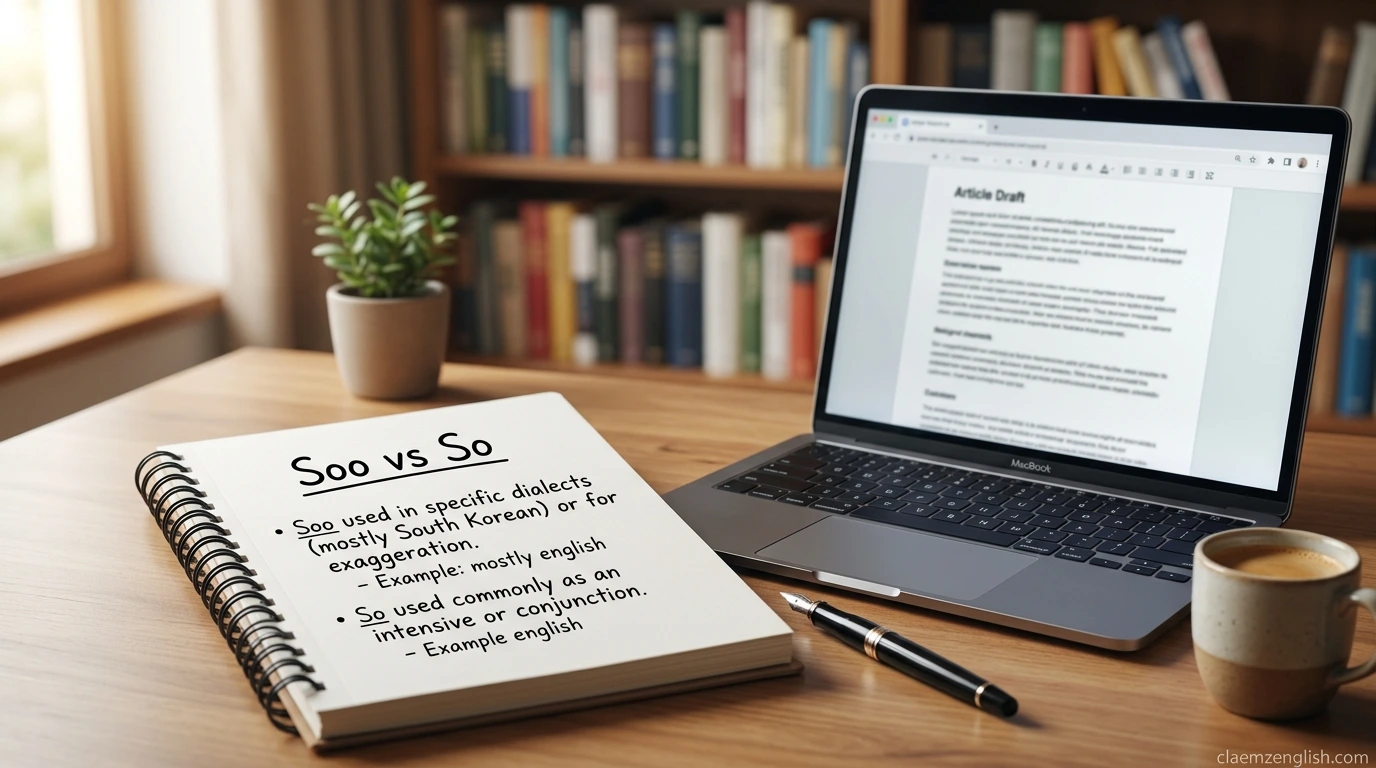
Many English learners often get confused between “so” and “soo.” At first glance, they look almost the same, but their usage in real writing and speaking is very different. This confusion usually appears in text messages, social media posts, casual writing, and sometimes even in informal emails. However, when it comes to exams, professional communication, or academic writing, using the correct form becomes very important.
The word “so” is a proper English word with multiple grammatical uses, while “soo” is not considered standard English. Yet, people still use “soo” in informal digital communication to add emotion, emphasis, or tone. Understanding the difference between them helps you avoid spelling mistakes, improve clarity, and sound more confident in English.
In this article, you will learn the exact difference between so vs soo, how each is used, common mistakes, sentence examples, and easy tips to remember the correct usage. Let’s break it down in a simple and practical way so you can improve your English quickly and confidently.
Meaning and Basic Difference Between “So” and “Soo”
To understand the difference clearly, we first need to know what each form represents.
✔ “So” (Correct English Word)
“So” is a standard English word used in grammar as:
- An adverb
- A conjunction
- An intensifier
- A connector of ideas
It is used in formal and informal English.
Examples:
- I was so tired yesterday.
- She is so beautiful.
- I studied hard, so I passed the exam.
❌ “Soo” (Non-standard form)
“Soo” is not an official English word in standard grammar. It is mainly used in:
- Informal texting
- Social media writing
- Emotional emphasis (slang style)
Examples in casual use:
- I am sooo happy!
- That movie was sooo good!
👉 Important: In proper English writing, “soo” should be avoided.
Quick Difference Table
| Feature | So | Soo |
| Grammar status | Correct English word | Informal/slang spelling |
| Usage | Formal + informal | Only informal texting |
| Meaning | Shows degree, reason, result | Emphasis or emotion |
| Acceptable in exams | Yes | No |
| Dictionary entry | Yes | No |
Is “Soo” Correct or Just a Spelling Mistake?
One of the biggest questions learners ask is whether “soo” is correct English.
✔ The truth:
“Soo” is not considered correct grammar or spelling in standard English dictionaries.
However, language on the internet evolves. People sometimes stretch words like:
- so → sooo
- no → nooo
- yes → yesss
This is done to express emotion, tone, or excitement.
Where “soo” is used:
- WhatsApp chats
- Instagram captions
- Casual conversations
- Emotional expressions
Where “soo” is NOT used:
- School exams
- IELTS/TOEFL writing
- Business emails
- Formal documents
Example Comparison
| Context | Correct Form | Informal Form |
| Academic writing | I am so happy | ❌ I am soo happy |
| Text message | I am so tired | ✔ I am sooo tired |
| The result is so important | ❌ The result is soo important |
👉 Key takeaway: “soo” is emotional slang, not proper grammar.
Grammar Rules for Using “So” Correctly
The word “so” is extremely versatile. It can change meaning depending on how it is used in a sentence.
1. “So” as an intensifier
Used to show degree or intensity.
Examples:
- It is so cold today.
- She is so smart.
2. “So” as a conjunction (showing result)
Used to connect two ideas.
Structure:
Sentence + so + result
Examples:
- I was late, so I missed the bus.
- It was raining, so we stayed home.
3. “So” for agreement
Used in conversational English.
Examples:
- “I think it will rain.”
- “So do I.”
4. “So” in questions or expressions
- So what?
- So now what?
- So you are coming?
Grammar Rule Table
| Usage Type | Function | Example |
| Intensifier | Shows degree | She is so kind |
| Connector | Shows result | I was tired, so I slept |
| Agreement | Similar opinion | So do I |
| Emphasis | Strong feeling | I am so excited |
Sentence Examples (Correct vs Incorrect Usage)
Understanding mistakes is one of the fastest ways to learn.
✔ Correct Examples with “So”
- I am so happy today.
- The food is so delicious.
- He is so talented.
- She was so angry.
❌ Incorrect Examples with “Soo”
- I am soo happy today. (Wrong in formal writing)
- The food is soo delicious. (Informal only)
- He is soo talented. (Not standard English)
- She was soo angry. (Not acceptable in exams)
Side-by-Side Comparison
| Correct English | Incorrect/Informal Version |
| I am so tired | I am soo tired |
| She is so kind | She is sooo kind |
| It is so cold | It is soo cold |
| He is so fast | He is soo fast |
Real-Life Usage Tip
- Use “so” in writing, exams, and professional communication.
- Use “soo” only in friendly texting when tone matters more than grammar.
Common Mistakes Learners Make
Many English learners mix up “so” and “soo” without realizing the impact.
1. Overusing “soo” in writing
People sometimes write:
- This is sooo important for my assignment.
👉 Problem: Not acceptable in formal contexts.
2. Confusing “so” with “very”
Both show intensity, but they are used differently.
- Correct: I am so tired.
- Also correct: I am very tired.
But:
- “So tired” often needs context (cause or emotion).
3. Missing comma when using “so” as conjunction
Incorrect:
- I was tired so I slept.
Correct:
- I was tired, so I slept.
4. Using “so” repeatedly in sentences
- I am so so tired (unnecessary repetition)
Better:
- I am extremely tired.
Mistake Summary Table
| Mistake | Problem | Correct Form |
| Using “soo” in exams | Informal slang | Use “so” |
| No comma before “so” | Grammar error | Add comma |
| Repetition (“so so”) | Redundant | Use “very” or “extremely” |
| Wrong tone usage | Casual vs formal mix | Choose correct context |
“So” vs “Soo” Comparison Tables
Let’s clearly compare both forms in different ways.
Table 1: Grammar and Usage
| Feature | So | Soo |
| Word type | Adverb, conjunction | Informal expression |
| Dictionary valid | Yes | No |
| Formal writing | Yes | No |
| Emotional tone | Neutral | Strong/emotional |
Table 2: Context Usage
| Situation | So | Soo |
| Exam writing | ✔ | ❌ |
| Emails | ✔ | ❌ |
| Text messages | ✔ | ✔ |
| Social media captions | ✔ | ✔ |
| Academic essays | ✔ | ❌ |
Table 3: Meaning Impact
| Expression | Meaning |
| I am so happy | Normal happiness |
| I am soo happy | Extra emotional excitement |
| That is so funny | Neutral emphasis |
| That is sooo funny | Strong emotional reaction |
Pronunciation and Speaking Usage
Although spelling differs, pronunciation is where confusion often disappears.
✔ “So” pronunciation
- Pronounced as: /soʊ/
- Sounds like “sow” (rhymes with go)
❌ “Soo” pronunciation
- Not standard
- When spoken, it usually sounds the same as “so”
- The extra “o” is only written for emphasis
Spoken English Insight:
Even when people write “sooo,” they usually still say:
- “so” (with stress or tone)
Example:
- “I am sooooo happy!”
Spoken: “I am SO happy!” (with strong emphasis)
Key Tip:
In spoken English, tone matters more than spelling extensions.
FAQs
1. Is “soo” a real English word?
No, “soo” is not a standard English word. It is informal slang used for emotional emphasis.
2. Can I use “soo” in exams?
No, you should always use “so” in exams and formal writing.
3. Why do people write “sooo” on social media?
To show strong emotion, excitement, or exaggeration.
4. Is “so” always correct?
Yes, “so” is a correct English word with multiple grammatical uses.
5. What is the safest choice between so vs soo?
Always use “so” unless you are casually texting friends.
6. Does “soo” change meaning?
No, it only adds emotional emphasis, not a new meaning.
Conclusion
The difference between “so” and “soo” is simple but very important for clear communication. The word “so” is a correct and standard English word used in grammar, writing, speaking, and professional communication. It can show intensity, connect ideas, and express agreement.
On the other hand, “soo” is not a standard English form. It is only used in informal digital communication to show emotion or exaggeration. While it may be common on social media or texting apps, it is not acceptable in academic or professional writing.
To improve your grammar and writing skills, always remember this rule:
👉 Use “so” for correct English.
👉 Use “soo” only for casual emotional expression.
Mastering this small difference can significantly improve your confidence in English writing and help you avoid common mistakes in exams, emails, and real-life communication.
