
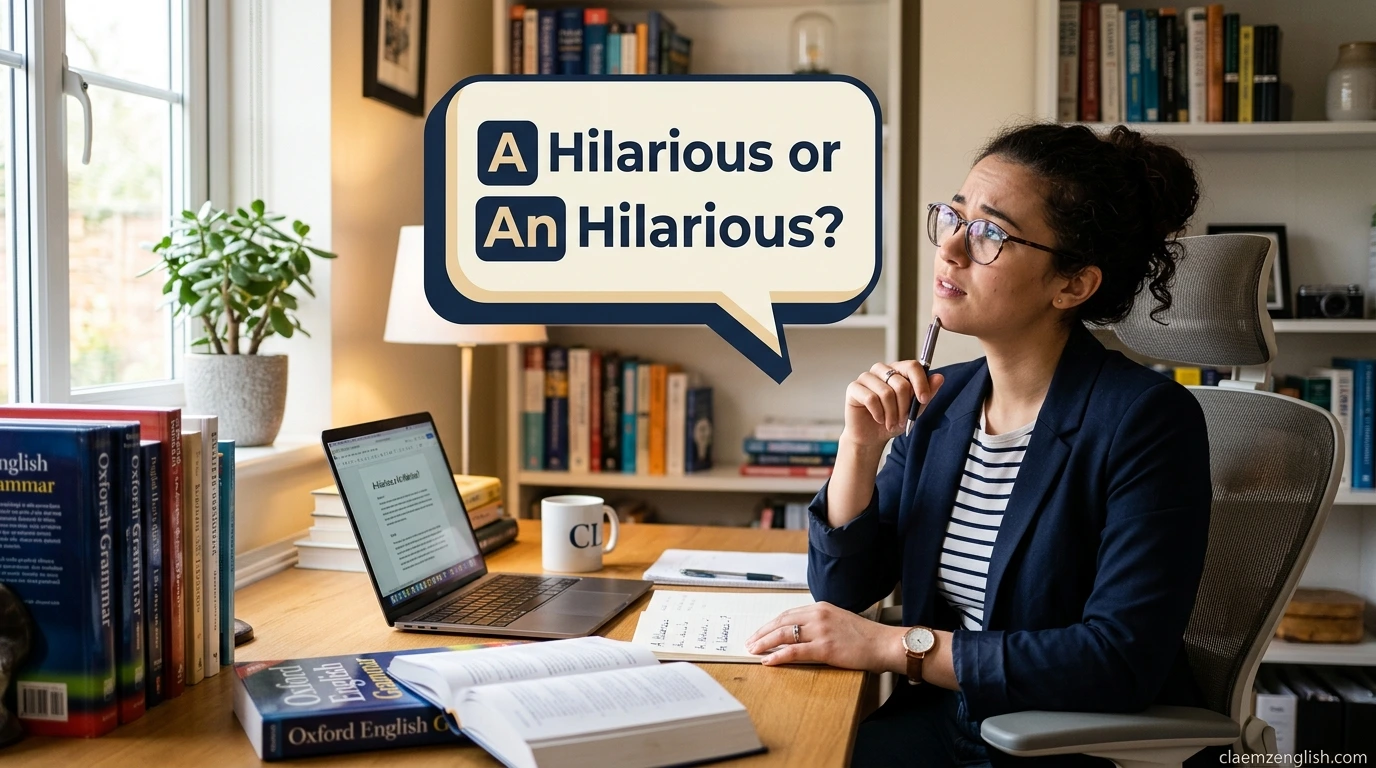
Have you ever paused while writing and wondered whether to use an hilarious or a hilarious? You’re not alone. This is one of the most common grammar questions among English learners and even native speakers. The confusion happens because the word hilarious starts with the letter H, but articles like a and an depend on sound, not spelling.
Using the correct article may seem like a small detail, but it makes your writing sound natural and professional. Whether you’re writing an essay, sending an email, preparing for an English exam, or speaking in a meeting, understanding this rule helps you communicate more confidently.
In this guide, you’ll learn the correct usage, pronunciation rules, grammar tips, real-life examples, common mistakes, and easy ways to remember whether to say a hilarious or an hilarious.
Is It “A Hilarious” or “An Hilarious”?
The correct form in modern English is:
✅ A hilarious
Examples:
- A hilarious movie kept everyone laughing.
- She shared a hilarious joke.
- We watched a hilarious comedy last night.
The form an hilarious is considered uncommon in modern English. It may appear in some older books or be used by a small number of speakers who pronounce the H differently, but it is not the standard choice today.
Quick Answer
| Expression | Correct? | Notes |
| A hilarious | ✅ Yes | Standard in modern English |
| An hilarious | ⚠ Rare | Mostly found in older or formal speech with a silent H pronunciation |
For almost every situation, choose a hilarious.
Why Do People Get Confused?
Many learners are taught this simple rule:
- Use a before consonants.
- Use an before vowels.
Unfortunately, this rule is incomplete.
The real rule is:
Choose “a” or “an” based on the first sound of the following word—not the first letter.
Since hilarious begins with the pronounced /h/ sound (“hi-LAIR-ee-us”), it takes a.
Compare these examples:
| Word | First Sound | Correct Article |
| hilarious | /h/ | a hilarious |
| house | /h/ | a house |
| hotel | /h/ | a hotel |
| apple | vowel sound | an apple |
| elephant | vowel sound | an elephant |
| orange | vowel sound | an orange |
The pronunciation, not the spelling, determines the correct article.
The Grammar Rule Behind “A” and “An”
The indefinite articles a and an introduce singular countable nouns.
Use a before a consonant sound.
Examples:
- a book
- a university
- a European country
- a hilarious story
- a useful guide
Notice that university starts with the letter U, yet we say a university because it begins with the “yoo” sound.
Use an before a vowel sound.
Examples:
- an apple
- an umbrella
- an hour
- an honest person
- an exciting adventure
Although hour starts with H, the H is silent, so the word begins with a vowel sound.
Easy Rule to Remember
Think about what you hear, not what you see.
If the word begins with:
- a clear H sound → use a
- a vowel sound → use an
Since hilarious starts with a clear H sound:
✅ a hilarious performance
Pronunciation Makes the Difference
Pronunciation is the key reason why a hilarious is correct.
The word is commonly pronounced as:
hi-LAIR-ee-us
The first sound is a strong H sound.
That means:
- a hilarious joke ✅
- a hilarious moment ✅
- a hilarious actor ✅
Not:
- an hilarious joke ❌
Compare with Silent H Words
| Word | H Pronounced? | Correct Form |
| hilarious | Yes | a hilarious |
| history | Yes | a history |
| hotel | Yes | a hotel |
| house | Yes | a house |
| honest | No | an honest person |
| hour | No | an hour |
| heir | No | an heir |
The difference comes entirely from pronunciation.
British vs American English
This question often appears because some older British English usage preferred an before certain words beginning with H.
Modern American English
American English almost always uses:
- a historic event
- a hotel
- a horrible mistake
- a hilarious joke
Modern British English
British English today also generally prefers:
- a historic building
- a hotel
- a hilarious story
You may occasionally see:
- an historic event
- an hotel
- an horrific accident
These are traditional or stylistic choices rather than the standard modern form.
Where Does “An Hilarious” Fit?
The phrase an hilarious survives mainly in:
- older literature
- historical writing
- certain formal speaking styles
- rare dialects
In everyday English, business writing, academic work, journalism, and exams, a hilarious is the preferred choice.
| English Variety | Preferred Form |
| Modern American English | a hilarious |
| Modern British English | a hilarious |
| Older British usage | an hilarious (rare) |
Correct and Incorrect Examples
Seeing examples is one of the easiest ways to remember grammar rules.
Correct Examples
✅ We watched a hilarious comedy.
✅ She told a hilarious story.
✅ He shared a hilarious meme.
✅ They had a hilarious conversation.
✅ It was a hilarious performance.
Incorrect Examples
❌ We watched an hilarious comedy.
❌ She told an hilarious joke.
❌ He posted an hilarious video.
❌ It was an hilarious evening.
These incorrect examples sound unnatural in modern English.
More Everyday Sentences
- My brother has a hilarious sense of humor.
- That was a hilarious reaction.
- We heard a hilarious podcast yesterday.
- She gave a hilarious speech at the party.
- The teacher shared a hilarious classroom story.
Common Mistakes Learners Make
Many English learners repeat the same mistakes when choosing between a and an.
Mistake 1: Looking Only at the First Letter
Incorrect thinking:
“The word starts with H, so maybe I should use an.”
Correct thinking:
“Does the H make a sound?”
Since it does:
✅ a hilarious joke
Mistake 2: Memorizing Spelling Instead of Pronunciation
English pronunciation doesn’t always match spelling.
Examples:
- an hour
- an honest person
- an heir
But:
- a history lesson
- a hotel room
- a happy child
- a hilarious moment
Mistake 3: Copying Older English
Older books sometimes use:
- an historic
- an hotel
- an heroic
Modern English generally prefers:
- a historic
- a hotel
- a heroic
The same applies to hilarious.
Mistake 4: Applying One Rule Everywhere
Some learners assume:
Every vowel letter = an
Every consonant letter = a
This doesn’t work because English depends on pronunciation.
Easy Tips to Remember the Correct Usage
Remembering one simple trick can prevent this mistake forever.
Tip 1: Say the Word Aloud
Ask yourself:
“Do I hear an H?”
If yes:
Use a.
Tip 2: Focus on the Sound
Examples:
- hilarious → H sound → a
- house → H sound → a
- history → H sound → a
Tip 3: Memorize Silent H Words
These always take an:
- an hour
- an honest person
- an heir
- an honor (American spelling)
Tip 4: Read Modern English
Current newspapers, novels, websites, and professional writing overwhelmingly use:
- a hilarious joke
- a hilarious movie
- a hilarious comment
Exposure to modern English helps build natural habits.
FAQs
Is “an hilarious” ever correct?
Technically, yes—but only in very limited situations where the speaker does not pronounce the H. This pronunciation is rare today, so most grammar experts recommend a hilarious.
Why isn’t it “an hilarious” if H is sometimes silent?
Because the H in hilarious is normally pronounced.
The pronunciation begins with the /h/ sound.
Is “a hilarious” correct in exams?
Yes.
It is the standard answer expected in:
- school exams
- university writing
- English proficiency tests
- business communication
- professional writing
Do dictionaries recommend “a hilarious”?
Yes.
Modern dictionaries pronounce hilarious with a clear H sound, making a hilarious the standard form.
Does British English still use “an hilarious”?
It is extremely uncommon today.
Modern British English generally uses a hilarious, just like American English.
Is this rule true for all H words?
No.
It depends on pronunciation.
Examples:
- a hero
- a horse
- a hotel
- a history lesson
But:
- an hour
- an honest answer
- an heir
- an honor
Always listen to the first sound.
Conclusion
The correct choice in modern English is a hilarious, not an hilarious. The reason is simple: articles are determined by pronunciation, not spelling. Since hilarious begins with a clearly pronounced H sound, it takes the article a.
Although an hilarious appears occasionally in older texts or rare traditional speech, it is not the standard form used in everyday English today. Whether you’re writing essays, emails, social media posts, academic papers, or professional documents, using a hilarious will sound natural, accurate, and up to date.
Whenever you’re unsure about a or an, remember this easy rule:
- If the next word begins with a consonant sound, use “a.”
- If the next word begins with a vowel sound, use “an.”
Say the word aloud, listen to its first sound, and let pronunciation—not spelling—guide your choice. With this simple habit, you’ll avoid one of the most common article mistakes and write with greater confidence every time.
